<?xml version="1.0" encoding="UTF-8"?>
<?xml-stylesheet type="text/xsl" href="/stylesheets/feed.atom.xml" media="screen"?>
<feed xml:lang="en-US" xmlns="http://www.w3.org/2005/Atom">
  <id>tag:crossingthesquare.nd.edu,2005:/articles</id>
  <link rel="alternate" type="text/html" href="https://crossingthesquare.nd.edu"/>
  <link rel="self" type="application/atom+xml" href="https://crossingthesquare.nd.edu/articles.atom"/>
  <id>tag:crossingthesquare.nd.edu,2005:/latest</id>
  <title>Crossing the Square | Articles</title>
  <updated>2026-02-04T11:21:00-05:00</updated>
  <link rel="alternate" type="text/html" href="https://crossingthesquare.nd.edu/"/>
  <link rel="self" type="application/atom+xml" href="https://crossingthesquare.nd.edu//articles.atom"/>
  <subtitle>A forum for collaborative research and the voices of scholars and leaders from within our Catholic Universities Partnership.</subtitle>
  <entry>
    <id>tag:crossingthesquare.nd.edu,2005:News/178993</id>
    <published>2026-02-04T11:21:00-05:00</published>
    <updated>2026-02-05T11:21:57-05:00</updated>
    <link rel="alternate" type="text/html" href="https://crossingthesquare.nd.edu/articles/hope-is-action-education-is-hope/"/>
    <title>Hope is action. Education is hope.</title>
    <summary type="text">
      <![CDATA[Authors’ Note: The authors made a thoughtful and considered decision to write this piece using the first person, even though only one of the three authors is Ukrainian and lives and works in situ. Some of the experiences described here are drawn from the direct experience of one…]]>
    </summary>
    <content type="html">
      <![CDATA[<p><em><strong>Authors’ Note: </strong>The authors made a thoughtful and considered decision to write this piece using the first person, even though only one of the three authors is Ukrainian and lives and works in situ. Some of the experiences described here are drawn from the direct experience of one author; the interpretation and position are shared by all three. We note that Sofiya Opatska lives in Ukraine, serving as the vice-rector of strategic development at Ukrainian Catholic University (UCU) in Lviv. Amy Kenworthy has a formal position as a visiting professor at UCU and was in Lviv at the time of this writing. Jessica McManus Warnell is a faculty member at the University of Notre Dame. Sofiya, Amy, and Jessica are engaged in ongoing research on the topic of business educator and practitioner hope amid crisis.</em></p>
<hr>
<p>As we approach four years of the full-scale invasion of Russia into Ukraine, we would like to reflect on what it means to be an educator living and working in a country experiencing violent conflict every day.</p>
<p>The invasion is causing a massive humanitarian crisis. Often in international news, we see the question being asked: Do Ukrainians want peace? Of course. It is what drives resilience and feeds hope. Every single day, Ukrainians live within an unpredictable and unknown environment with constant attacks on both civilians and the infrastructure that provides basic needs.</p>
<figure class="image image-left"><img src="https://nanovic.nd.edu/assets/647078/img_5586_1_.jpg" alt="A snowy winter scene seen through a window adorned with purple string lights and white decals of a snowman, houses, and trees. Outside, a white domed building with a cross and a modern grey building flank a snow-covered path where two people walk." width="600" height="400">
<figcaption>Winter at UCU.</figcaption>
</figure>
<p>As an example, which took place as we were working on this essay, on January 8th, 2026, many universities in Kyiv had to make quick morning decisions to completely switch to online teaching. They had to ask their students to leave Kyiv and go home due to the overnight destruction of critical infrastructure by Russia, which left most of the city (including students’ dormitories) without water, electricity, and heat. In January, in Ukraine, temperatures average well below zero. Although huge efforts are put into repairing systems quickly and efficiently, life is not possible without heat and water, so once again, the lives of Ukrainians are disrupted in dangerous ways.</p>
<p>Here, we feel that it is important to note that the Russian targeting, destruction, and resultant damage to educational infrastructure occur systematically, regardless of the territory of active hostilities. To date, from the start of Russia’s full-scale invasion of Ukraine in February 2022, a total of 4,048 <a href="https://saveschools.in.ua/en/">educational institutions in Ukraine have been affected by bombing and shelling</a>, and 408 of them have been completely destroyed.</p>
<blockquote class="pull">
<p>... although there is no idea what each new day will bring, the role, responsibilities, and all associated activities of the University must be focused on learning and growth for decades, and perhaps also centuries, to come.</p>
</blockquote>
<p>According to the World Bank, the war continues to have profound physical, psychological, social, economic, and environmental impacts, which will be felt for generations to come. In these horrific conditions, thousands of educators continue to teach both online and in situ on campuses (depending on where the institution is located) as education is recognized as an institution critical to managing the future of the country. Ukrainians must, and will, keep our universities running. This is especially important in a country where one cannot imagine what each day and night will bring with it. So many of the nights in Ukraine are disrupted, often for hours on end, with air raid alarms due to missile and drone attacks. While developing a strategic plan at the Ukrainian Catholic University (UCU) in 2023, the management team realized that although there is no idea what each new day will bring, the role, responsibilities, and all associated activities of the University must be focused on learning and growth for decades, and perhaps also centuries, to come.</p>
<p>During the summer of 2025, our team, Sofiya Opatska (UCU), Jessica McManus Warnell (University of Notre Dame), and Amy Kenworthy (Bond University in Australia and UCU Business School), interviewed 16 faculty members teaching at UCU Business School. We were interested in learning their perspectives on the role of hope for themselves, their students, and for Ukraine’s future in an environment rife with uncertainty and destruction.</p>
<figure class="image image-right"><img src="https://nanovic.nd.edu/assets/647086/2025_02_08_2025_039jpg.jpg" alt="A female graduate in a black cap and gown with a gold academic hood looks attentively to her left, in a line of other graduates at a ceremony." width="600" height="400">
<figcaption>Students from the Class of 2025 at UCU.</figcaption>
</figure>
<p>It is important to note that the majority of the educators who were interviewed have senior positions in business organizations or came to education from industry to combine teaching with business management roles in education. Their choice to teach in such difficult times is a conscious commitment to supporting the next generation and the future of Ukraine.</p>
<p>As one of the faculty members and director of M.Sc. in Marketing Management program, Igor Blystiv, shared:</p>
<p style="padding-left: 40px;">I remember the first meeting with a group of students in 2022. It was around one month after the start of the invasion. I said to them: “If we choose to stay in Ukraine (as people, as company representatives), we need to create value, we need to organize more socially responsible projects. So let's try to think what we can do in five minutes, in one hour, in one day, in one week, or even in one year.” I also said marketing is still here, and we need to care about our clients, about our customers, about each other. So let's try to do this, and please try to find some routines, because it brings perspective that tomorrow will be the same and will make you feel fine. It was a very timely conversation, as after class some of the students came to me and said: it was very important to us to hear that everything can be fine, we can stay here and we can do what we can to help our companies, our clients, and our country.</p>
<figure class="image image-default"><img src="https://nanovic.nd.edu/assets/647074/fullsize/dsc040ffff25.jpg" alt="A woman in a light blouse speaks, gesturing to an audience of mostly men seated at tables in a presentation room. A banner promoting" width="1200" height="675" is="">
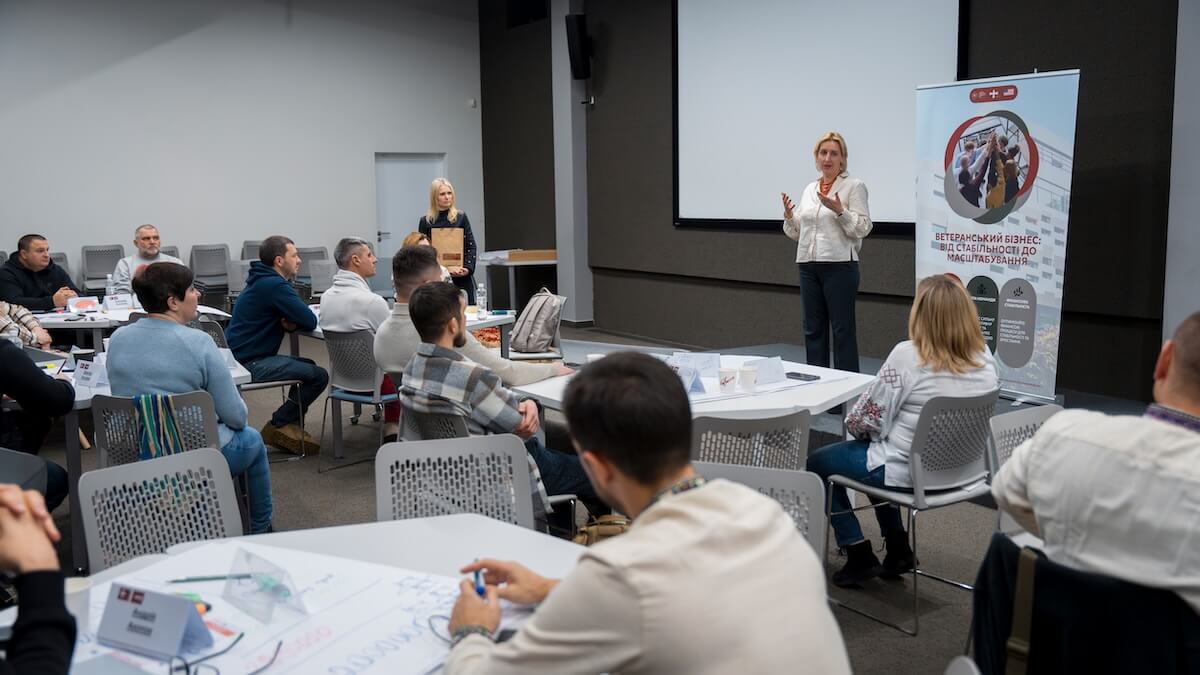
<figcaption>Opatska speaks at the Veteran’s Entrepreneurship program at UCU.</figcaption>
</figure>
<p>This small interaction between faculty and students in a time of crisis shows the complex and multifaceted roles educators have right now in Ukraine. Some of the activities the faculty we spoke with find themselves engaging in regularly include:</p>
<ul>
<li dir="ltr" aria-level="1">
<p>Talking to students about recent events related to the attacks and other geopolitical movements in the world (these discussions range in terms of temporal focus from an attack the night before to the four years since the full-scale invasion began);</p>
</li>
<li dir="ltr" aria-level="1">
<p>Focusing on purpose—how we can help our country and what roles we can each play in that movement;</p>
</li>
<li dir="ltr" aria-level="1">
<p>Sharing vulnerably and transparently about the challenges of maintaining a healthy mental and physical state and, relatedly, how we can practice self-care;</p>
</li>
<li dir="ltr" aria-level="1">
<p>Role modeling the importance of having a basic structure for each day and the small wins that those simple structures provide;</p>
</li>
<li dir="ltr" aria-level="1">
<p>Bringing normality and a sense of safety to students’ environments; and</p>
</li>
<li dir="ltr" aria-level="1">
<p>Creating spaces for care and connection for students so that they know they are members of a unified community—this helps them to continue through the chaos and, even in small ways, to make some sense of nonsense.</p>
</li>
</ul>
<figure class="image image-left"><img src="https://nanovic.nd.edu/assets/647076/img_5190.jpg" alt="Four young women sit on an indoor tiled staircase, smiling and talking. One in a maroon hoodie with" width="600" height="441">
<figcaption>Students at UCU studying in a public area.</figcaption>
</figure>
<p>The typical job description for university educators will not include most of the above. At UCU, formal roles do not include these things either. Yet, we live in a world in which these responsibilities have moved to the forefront of who we are and what we do. Indeed, the situation in Ukraine begs the question of how much traditional job descriptions accurately reflect the most important parts of what we as educators do. In different ways and within different types of crises (e.g., health, financial, geopolitical, environmental, social, war), we will each be asked to respond to students’ changing social, psychological, and physical needs in a highly fragmented and volatile world.</p>
<p>In an example of what another UCU educator, Iryna Tymoshchenko-Petrova, who teaches organizational behavior and human resource management, shared:</p>
<p style="padding-left: 40px;">With every topic, I try to contextualise it—the topic and the war. If I’m teaching about motivation, then it’s motivation during the war; if it’s strategy, then it’s strategy during the war. Every time I teach, I try not to have illusions, but share reality and hope students will not have illusions. I try to show a clear situation—a real situation, because in a real situation, we have facts and we can change something.</p>
<blockquote class="pull">
<p>"I have to be honest with myself that whatever I teach them, <strong>it matters,</strong> and it's worth investing their minds now. Every lecture for me is like mentorship."</p>
</blockquote>
<p>Exploring how educators are adapting within war, at UCU, we understand that teaching in Ukraine is also a huge responsibility in terms of the pressure and high expectations students have for themselves as they determine their roles in building Ukraine’s future. Ivan Petrenko, the UCU Director of Ideas Center and educator in the area of entrepreneurship, illustrates this through this reflection:</p>
<p style="padding-left: 40px;">The best thing to describe teaching here is not just sharing facts and providing information to the students, but giving them meaning of their time—chaos in war, talking to them about resilience, about dignity. So things that would help them understand that studying at university, not just to get their diploma, but to become someone bigger and to help rebuild Ukraine, because they're choosing to stay in the country. And I have to be honest with myself that whatever I teach them, it matters, and it's worth investing their minds now. Every lecture for me is like mentorship.</p>
<figure class="image image-right"><img src="https://nanovic.nd.edu/assets/647079/img_6731_1_.jpg" alt="A smiling, bald, bearded man in a black clerical garment speaks into a microphone, gesturing to a large, diverse audience of young people seated on chairs and the floor in a brightly lit hall." width="600" height="400">
<figcaption>Metropolitan-Archbishop Borys Gudziak, president of the university, addresses the UCU first-year student body.</figcaption>
</figure>
<p>Unlike previous decades, many young people today, especially in Ukraine, have little idea what their future might look like. As Catholic university communities, both UCU and Notre Dame have a longstanding practice of working to nurture the concept of Integral Human Development into everything we do. Integral Human Development (IHD) is a holistic approach to human flourishing which emphasizes the development of the whole person (economically, socially, culturally, politically, and spiritually), promoting their dignity, equality, and the common good in a just community, thus moving beyond a focus on material wealth to one that is centered upon spiritual and relational well-being. The IHD concept was chosen by our two institutions to serve the growth and development of students, with the aim of creating an educational environment in which students are nurtured and supported to become not only better professionals but flourishing human beings.</p>
<p>Returning to what it is like teaching within war in Ukraine, on one hand, war has little to do with humanistic attributes of character, though it highlights the clear need for humans to engage and connect in ways that require having hope. Yet Ukrainians live in a place and time where no one knows what each day will bring. Rationally, given how long the invasion has continued and the fact that there is no end in sight, Ukrainians should be feeling relatively hopeless. Our interviews showed that for educators at UCU, hope has a very special meaning of action, not one of wishful expectation.</p>
<p>As Volodymyr Turchynovsky recently <a href="https://nanovic.nd.edu/news/one-year-after-notre-dame-thinking-with-gratitude-from-ukraine/">wrote in a blog</a>: For Ukrainians, hope serves. It cooks, shelters, teaches, rebuilds, and fights. It is the moral energy of a society that refuses to give up on its own humanity.</p>
<p>Roksolyana Voronovska, who teaches in the area of strategy and business design, clearly defined this contextualization for us:</p>
<p style="padding-left: 40px;">Hope is action. The idea is that you have an action and something tied to the action. The words in Ukrainian are ‘Na Dia’, and Dia means action. Hope must include action. You quickly realize when living within war that the romantic ideal of hope doesn’t exist. Without effort and critical thinking, there is no hope.</p>
<figure class="image image-default"><img src="https://nanovic.nd.edu/assets/647088/fullsize/img_6981.jpg" alt="A large group of young people sit and stand on a sunny green lawn, arranged in a crescent around a blue and yellow Ukrainian flag. Behind them stands a cream-colored Orthodox church with dark domes." width="1200" height="800">
<figcaption>First-year students in the Class of 2029 gather at UCU.</figcaption>
</figure>
<p>In the context of education, Olena Kuzmichova, who teaches crisis management, shared so beautifully,</p>
<p style="padding-left: 40px;">Things give you hope when you know the next piece is reachable. Here, at UCU as we teach while living in war, hope is creating community, building something, and making a change… and we strive to make little changes every day because they are all little successes tied to hope.</p>
<p>As the above reflections indicate, for those who are living and teaching within war, hope needs rethinking. Ukrainian educators have to keep moving forward, doing things, achieving small wins, working together, creating community, supporting students and each other as well as those who fight so bravely and are rising and giving their lives for freedom. The educators we spoke with keep moving forward every day, not because it is easy. It is not. It is their choice to keep moving forward for their country, people, language, history, culture, and children’s futures. As Oleksandra Alkhimovych, who teaches human resource management and leadership, evocatively shared,</p>
<p style="padding-left: 40px;">Hope gives us the courage to make decisions despite fear, despite uncertainty. No one will believe a leader who does not have hope. I believe hope has three parts: it is a goal, it is planning, and it is the motivation to believe in yourself and follow through on your plans. For me, hope is the inner mission that activates planning.</p>
<blockquote class="pull">
<p>"... hope is creating community, building something, and making a change … and we strive to make little changes every day because they are all little successes tied to hope.... Hope gives us the courage to make decisions despite fear, despite uncertainty."</p>
</blockquote>
<p>We have been moved by the vulnerable insights and shared reflections of the educators who spoke with us, as we hope you will also. We use the word hope here intentionally and view our writing as the action that we believe will encourage action on the part of those who read this to enact hope through doing. Ideally, some of that will be in the direction of connecting with, supporting, sharing about, and partnering with colleagues at UCU.</p>
<p>Ukrainians are <a href="https://www.tandfonline.com/doi/full/10.1080/13562517.2024.2372574">calling out to be seen and heard</a>, and are grateful for those who continue to engage. As an example, for faculty who teach with cases, we have three published cases about Ukrainian leaders and how they are navigating the process of running a business in ways that are achieving significant social impact during the war. Each case has a clear connection to the IHD ethos and was written to serve as a catalyst for discussion about the role of motivation, connection, community, and hope. One is about <a href="https://www.iveypublishing.ca/s/product/leading-with-purpose-and-passion-through-war-in-ukraine/01tOF000006Gg34YAC">purpose and passion as keys to leadership within war</a>, another is about <a href="https://www.iveypublishing.ca/s/product/effectuation-during-conflict-entrepreneurial-thinking-to-provide-humanitarian-aid-in-ukraine/01tOF000006GgvuYAC">social entrepreneurship and effectuation</a>, and the third is about <a href="https://www.iveypublishing.ca/s/product/glamping-ukraine-an-entrepreneurs-pivots-agility-and-resilience-within-war/01tOF000009u8AcYAI">the necessity of pivoting when confronted with crisis</a>. Each is available through Ivey’s online catalog, and the royalties from each case go directly to support charities in Ukraine.</p>
<figure class="image image-default"><img src="https://nanovic.nd.edu/assets/647084/fullsize/2025_04_08_higheredtalk016jpg.jpg" alt='Three young women sit on grey chairs at a panel discussion. Left woman in maroon "Ukrainian Catholic University" hoodie smiles. Middle woman in glasses laughs while speaking into a microphone. Right woman wears a dark patterned sweater vest.' width="1200" height="800">
<figcaption>UCU students discuss their experiences.</figcaption>
</figure>
<p>We would like to conclude this essay with a comment from Oleg Chaharyn, an instructor of finance and data analytics, who shared,</p>
<blockquote class="pull">
<p>"Hope is action.... You quickly realize when living within war that the romantic ideal of hope doesn’t exist. Without effort and critical thinking, there is no hope."</p>
</blockquote>
<p style="padding-left: 40px;">I like Vaclav Havel’s (the first President of the Czech Republic) definition that hope is not an understanding that everything will turn out the way you want, but instead it is a belief that you are doing the right thing. We usually do not think about hope when everything is okay; rather, we turn to it when things are not okay. Out of the three—faith, hope, and love—hope is usually thought about the least. It can be seen as small comparatively. But as it turns out, this small piece—hope—can give you everything.</p>
<p>The research project “Hope in Action: Exploring Ukrainian Educators’ Understanding, Cultivation, and Enactment of Hope Within War” is supported by the <a href="https://nanovic.nd.edu/">Nanovic Institute for European Studies</a>, <a href="https://keough.nd.edu">Keough School of Global Affairs</a>.</p>
<p class="attribution">Originally published by <span class="rel-author">Sofiya Opatska, Amy Kenworthy, and Jessica McManus Warnell</span> at <span class="rel-source"><a href="https://nanovic.nd.edu/news/hope-is-action-education-is-hope/">nanovic.nd.edu</a></span> on <span class="rel-pubdate">February 04, 2026</span>.</p>]]>
    </content>
    <link rel="enclosure" type="image/jpeg" href="https://crossingthesquare.nd.edu/assets/647637/image0_2_.jpeg" title="Three smiling women stand around a table with large white papers covered in blue handwritten brainstorming notes, diagrams, and circled words like &quot;HOPE.&quot;"/>
    <author>
      <name>Sofiya Opatska, Amy Kenworthy, and Jessica McManus Warnell</name>
    </author>
  </entry>
  <entry>
    <id>tag:crossingthesquare.nd.edu,2005:News/178994</id>
    <published>2025-12-15T11:23:00-05:00</published>
    <updated>2026-02-05T11:23:13-05:00</updated>
    <link rel="alternate" type="text/html" href="https://crossingthesquare.nd.edu/articles/the-ukrainian-studies-hub-brings-musicians-scholarship-and-new-partnerships/"/>
    <title>The Ukrainian Studies Hub brings musicians, scholarship, and new partnerships</title>
    <summary type="text">
      <![CDATA[As the academic year began, the Nanovic Institute for European Studies marked September with a powerful series of Ukraine-focused events that brought together global partnership, cultural testimony, and scholarly insight. Together, these three moments reflect the institute’s ongoing commitment to…]]>
    </summary>
    <content type="html">
      <![CDATA[<p>As the academic year began, the Nanovic Institute for European Studies marked September with a powerful series of Ukraine-focused events that brought together global partnership, cultural testimony, and scholarly insight. Together, these three moments reflect the institute’s ongoing commitment to fostering dialogue, solidarity, and informed understanding of Ukraine at a critical time in its history.</p>
<h2 dir="ltr">Notre Dame joins Global Coalition of Ukrainian Universities</h2>
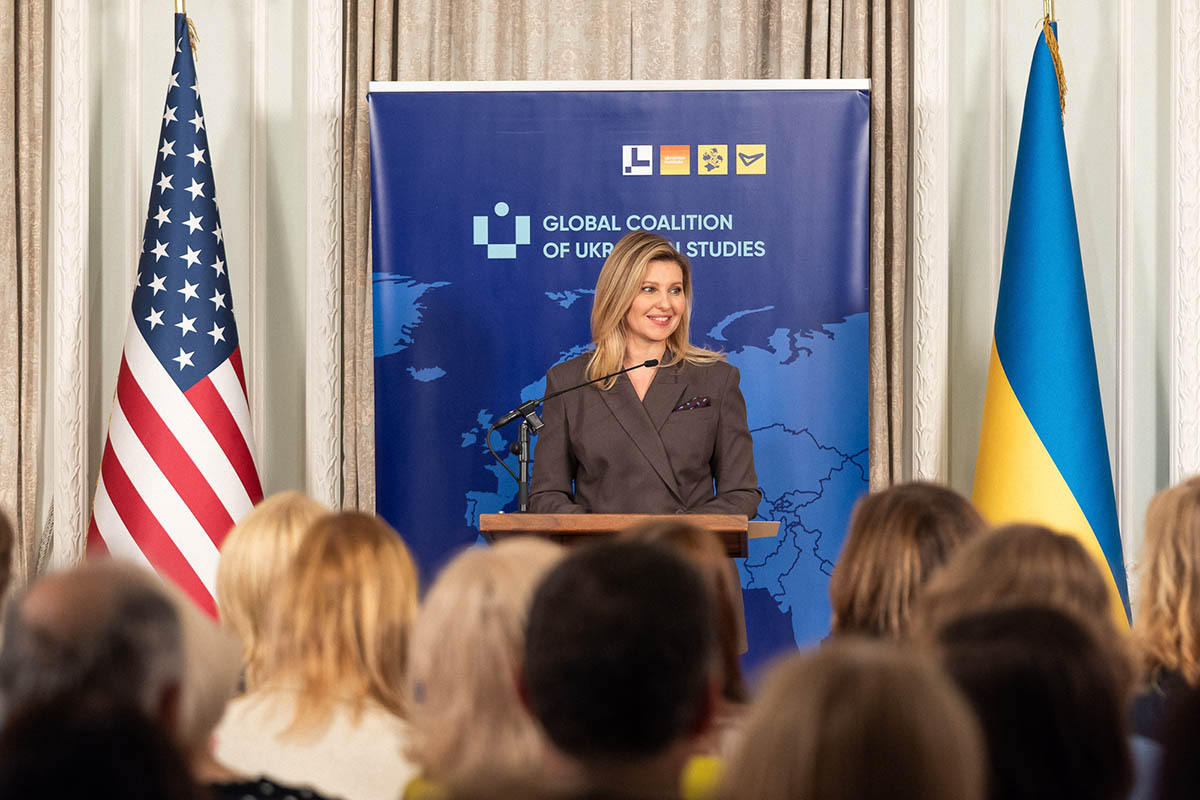
<p>This September, the University of Notre Dame formally entered the Global Coalition of Ukrainian Studies, formalized in a public event and panel in New York City with Olena Zelenska, the First Lady of Ukraine. Through this step, Notre Dame joins a growing international network dedicated to strengthening Ukrainian higher education, promoting collaborative research, and supporting students and scholars affected by the ongoing war.</p>
<figure class="image image-default"><img src="https://nanovic.nd.edu/assets/632785/fullsize/zelenska.jpg" alt="A woman with blonde/brown hair in a gray suit, Olena Zelenska, speaking at a podium. Framed on either side are the flags of the United States and Ukraine. Behind her directly is a banner for the Global Coalition of Ukrainian Studies." width="1200" height="800">
<figcaption>Olena Zelenska, Ukraine's First Lady and founder of the Coalition of Ukrainian Studies, speaks at an event on September 24, 2025, welcoming the University of Notre Dame and four other organizations into the coalition.</figcaption>
</figure>
<p>Membership in the coalition underscores Notre Dame’s commitment to international solidarity and aligns closely with the mission of the Nanovic Institute to build global partnerships rooted in dignity, academic exchange, and long-term resilience.</p>
<h2 dir="ltr">Ukrainian Rockstar Slava Vakarchuk: Music, testimony, and a call to action</h2>
<p><iframe width="560" height="314" src="https://www.youtube.com/embed/lwoESpjDghs" allowfullscreen="allowfullscreen"></iframe></p>
<p>The Nanovic Institute also hosted Ukrainian rock musician Slava Vakarchuk to speak on campus while he was touring across the United States, raising funds for Ukrainian communities impacted by the war. Blending performance with personal testimony, Slava spoke about the realities of life in Ukraine today and the urgency of sustaining international support. This invited the Notre Dame community to encounter Ukrainian voices in a personal way. By sharing his story and using his platform for advocacy, Slava brought a human dimension to the conflict, a powerful reminder of the power of culture to mobilize compassion.</p>
<h2 dir="ltr">Professor Rory Finnin on the Chornobyl Madonna: Culture, faith, and the birth of modern Ukraine</h2>
<p>To complete the week of Ukrainian Hub events, the Nanovic Institute welcomed visiting Professor Rory Finnin of Ukranian Studies from the University of Cambridge, for a lecture. His lecture examined how art, silence, and faith have shaped Ukraine’s path from the Chornobyl disaster to independence.</p>
<figure class="image image-right"><img src="https://nanovic.nd.edu/assets/641166/rory_finnin.jpg" alt="Professor Rory Finnin giving a lecture from the Nanovic Institute podium." width="600" height="400">
<figcaption>Visiting professor from the University of Cambridge, Rory Finnin, speaks on the importance of the Chornobyl Madonna to Ukraine.</figcaption>
</figure>
<p>Finnin described Chornobyl as a catastrophe of consciousness that exposed the moral decay of the Soviet system and awakened a cultural response among Ukrainian writers and artists. He focused on Ivan Drach’s poem titled "The Chornobyl Madonna"<em data-start="628" data-end="651"> </em> in which the figure of Mary becomes a symbol of endurance and moral clarity amid devastation. Reflecting on the poem’s central figure, Finnin observed that “she is also a locus of horror,” a reminder of how the Madonna carries both the suffering of a wounded world and the strength that emerges from it. For Finnin, the Madonna embodies the resilience that later animated Ukraine’s democratic movement, which culminated in acts of collective courage such as the 1990 Living Chain.</p>
<p>The lecture offered a vivid reminder that Ukraine’s political awakening was not only a geopolitical event but also a cultural and spiritual one. It is a story of people transforming silence into voice and suffering into hope.</p>
<p>Joining the Global Coalition of Ukrainian Studies, hearing first-hand experiences about the ongoing war from Ukrainian musician Slava, and learning more about the country’s cultural history from Professor Finnin highlight the breadth of the Nanovic Institute’s commitment to Ukraine. As the year continues, the institute will create more opportunities for learning, solidarity, and global awareness, deepening our engagement with Ukraine and its people.</p>
<p class="attribution">Originally published by <span class="rel-author">Jane Porter</span> at <span class="rel-source"><a href="https://nanovic.nd.edu/news/the-ukrainian-studies-hub-brings-musicians-scholarship-and-new-partnerships/">nanovic.nd.edu</a></span> on <span class="rel-pubdate">December 15, 2025</span>.</p>]]>
    </content>
    <link rel="enclosure" type="image/jpeg" href="https://crossingthesquare.nd.edu/assets/647638/ukraine_field_.jpg" title="A vibrant golden wheat field stretches under a clear blue sky, forming the colors of the Ukrainian flag."/>
    <author>
      <name>Jane Porter</name>
    </author>
  </entry>
  <entry>
    <id>tag:crossingthesquare.nd.edu,2005:News/176606</id>
    <published>2025-11-17T16:25:00-05:00</published>
    <updated>2025-11-17T16:25:23-05:00</updated>
    <link rel="alternate" type="text/html" href="https://crossingthesquare.nd.edu/articles/one-year-after-notre-dame-thinking-with-gratitude-from-ukraine/"/>
    <title>One year after Notre Dame: Thinking with gratitude from Ukraine</title>
    <summary type="text">
      <![CDATA[Some thoughts, once shared in friendship, continue to grow within us. These reflections, first spoken at the University of Notre Dame in the fall of 2024, return now from Ukraine—tempered by time, war, and gratitude.  A year ago, in the fall of 2024, as a Visiting…]]>
    </summary>
    <content type="html">
      <![CDATA[<blockquote>
<p>Some thoughts, once shared in friendship, continue to grow within us. These reflections, first spoken at the University of Notre Dame in the fall of 2024, return now from Ukraine—tempered by time, war, and gratitude.</p>
</blockquote>
<p>A year ago, in the fall of 2024, as a Visiting Fellow at the Nanovic Institute for European Studies, part of the University of Notre Dame’s Keough School of Global Affairs, I spoke with students about Ukraine’s experience of living, studying, and thinking amid war. Those days on campus remain vivid in my memory even as days now pass in Ukraine, each carrying its own existential weight for every one of us here. The country that, for many, once seemed a distant periphery has instead proved to be a pivotal frontier for freedom and democracy—a true game changer in what was meant to be a swift restoration of the Russian empire.</p>
<p>The questions I was asked in classrooms and over coffee on the Notre Dame campus have stayed with me ever since; they helped shape and crystallize the thoughts that follow. A year later, I realize that many of those reflections have not only endured but have deepened in meaning.</p>
<p>What follows are ten concise points—messages, really—that I first shared at Notre Dame and that continue to resonate within the Ukrainian rhythm of everyday life, loss, and hope. Each seeks to capture a fragment of truth about friendship, faith, freedom, and moral imagination. Together they form a small gesture of gratitude to my friends and colleagues at Notre Dame—to all of you who keep thinking, learning, and believing that being truthful to the truth is both an act of freedom and a source of resilience.</p>
<h2><strong>On Friendship</strong></h2>
<figure class="image image-left"><img src="https://nanovic.nd.edu/assets/638318/ucu_group5x7.jpg" alt="A diverse group of about 25 smiling adults, professionally dressed, poses indoors. A man in a black cassock stands on the right. Many wear blue and yellow or yellow ribbon pins, suggesting support for Ukraine. A Nanovic Institute banner is on the left." width="600" height="428">
<figcaption>Members of the Nanovic Institute team join representatives from Ukrainian Catholic University for a photo at the Ukrainian Hub Conference "Revolutions of Hope: Resilience and Recovery in Ukraine," March 6-8, 2025.</figcaption>
</figure>
<p>My first message is about friendship.</p>
<p>When I first visited Notre Dame in 2006, the idea of a real partnership with the newly re-established Ukrainian Catholic University seemed improbable. Nearly two decades later, that friendship has matured into a living alliance, tested by war and sustained by shared purpose. During his visit to Ukrainian Catholic University (UCU) in 2024, Rev. John I. Jenkins, C.S.C., spoke of “both battles”: the military defense of Ukraine’s freedom and the educational work that equips a nation to build its future. He also named the moral ground of our partnership—solidarity that refuses to treat Ukraine as “just another part of the world,” reminding us that we belong to one human family.</p>
<p>I came to Notre Dame from a country under daily air-raid alarms. In such a world, resources indeed matter—to hold, to withstand, and to eventually win—yet the most decisive currency is trust. Trust makes cooperation possible across distance, while friendship strengthens resilience and turns cooperation into the future we dare to imagine.</p>
<p>Our institutions did not drift together by chance; they chose one another. In choosing, they discovered that friendship is not sentiment but infrastructure, an ethical bond strong enough to carry and enact hope.</p>
<h2><strong>On Death</strong></h2>
<blockquote class="pull">
<p>"... in wartime Ukraine, death is no abstraction. Its reality is stunningly present even in the most ordinary settings, including campus life."</p>
</blockquote>
<p>My second message is about death.</p>
<p>During UCU’s winter commencement on February 10, 2024, the valedictorian, Lubov Kurtiak, a mother of three and a graduate of the School of Journalism and Communication, offered words that have stayed with me ever since. Speaking with grace and quiet strength, she said that what makes UCU truly unique is that it “prepares you to face death.” Not in despair, she explained, but “in the context of living life honorably and in a dignified way, so that when your time comes to meet God, you stand before Him without regret.”</p>
<p>To speak of death in such a way—amid celebration, hope, and youth—may sound profoundly countercultural. Yet in wartime Ukraine, death is no abstraction. Its reality is stunningly present even in the most ordinary settings, including campus life. If you run a university during war, you know that all too well.</p>
<p>At UCU, we have lost students and colleagues whose names now mark our community’s calendar of remembrance. Through these sacrifices, the education of dignity becomes a lived response—a revelation of our university community’s resilience amid the vast disruption inflicted by Russia’s war of aggression against Ukraine.</p>
<h2><strong>On the Gift of Time</strong></h2>
<figure class="image image-right"><img src="https://nanovic.nd.edu/assets/638625/_2.jpg" alt="Students in a discussion circle on the UCU campus." width="600" height="400">
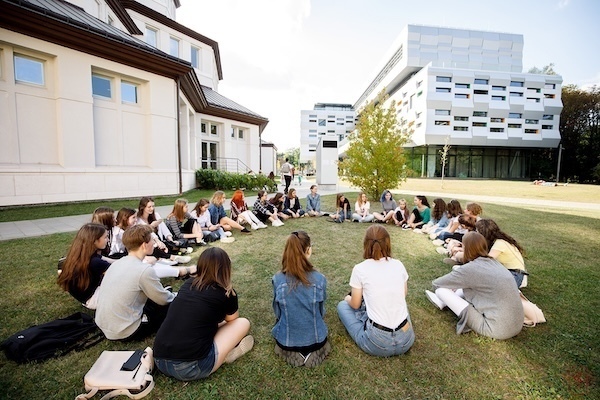
<figcaption>Students in a discussion circle on the UCU campus. Photo courtesy of Ukrainian Catholic University.</figcaption>
</figure>
<p>My third message is about time.</p>
<p>In Ukraine, time can no longer be taken for granted. It can stop in an instant—for one person or for many. Time has ceased to be a neutral medium in which our living unfolds and our plans take shape. It has become a moral presence—fulfilled through sacrifice and service.</p>
<p>Each day is a gift entrusted to us by those who stand guard on the frontlines and by those who support them through their labor, prayer, and love. It is a gift born of solidarity in action, scaled and sustained internationally by friends who, like my dearest colleagues at Notre Dame, stand firmly for what is just, true, and good.</p>
<p>To have a class during wartime is a gift. To complete an academic year is a gift. To hold a commencement while air alarms sound in the distance is a gift. These moments of learning and continuity do not belong to us; they are granted by others’ courage.</p>
<p>At UCU, we have come to understand that time, like freedom, carries responsibility. It is a gift that demands courage—to receive it gratefully, to use it wisely, and to give it generously in defense of dignity, in the fight for freedom, and in the winning of a just and lasting peace for our continent.</p>
<h2><strong>On Hope</strong></h2>
<figure class="image image-left"><img src="https://nanovic.nd.edu/assets/638342/theotoks.jpg" alt="Icon depicting the Virgin Mary in blue, tenderly cradling the Christ Child. He wears a gold tunic, holds a scroll, and offers a blessing. Both have serious expressions against a rich, patterned gold background with red Greek text." width="600" height="785">
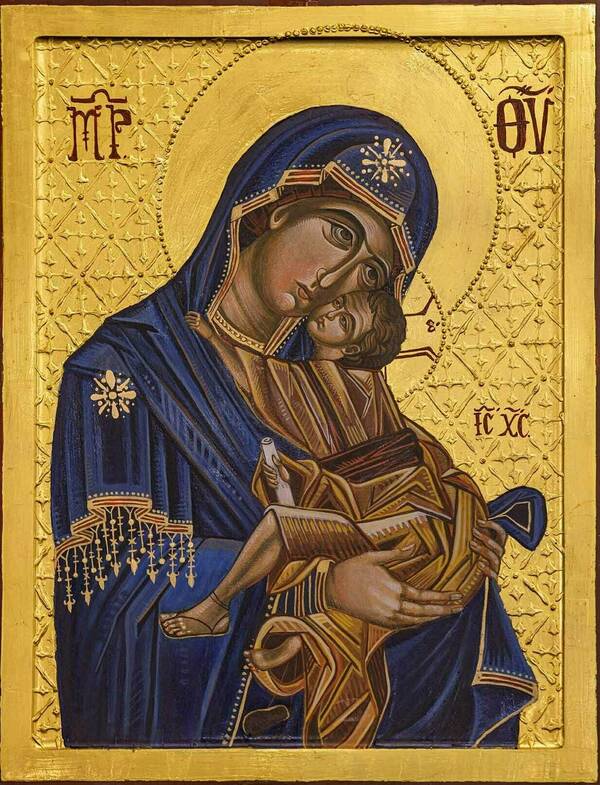
<figcaption>An icon of the Theotokos written by Anastassia Cassady (South Bend, IN) and presented to Ukrainian Catholic University.</figcaption>
</figure>
<p>My fourth message is about hope.</p>
<p>For Ukrainians, our country remains a land of hope. For my fellow citizens, hope is not a sentiment but a discipline of the spirit. A recent nationwide survey showed that even amid loss and exhaustion, a clear majority of Ukrainians, over 60 percent, name hope as their prevailing feeling about the country’s future. Only 40 percent mention anxiety, and a third speak of optimism. Hope prevails, and with it, agency and courage endure.</p>
<p>An American colleague once remarked after visiting Kyiv and Lviv: “Optimism in Ukraine has waned, but hope still abounds.” He was right. Hope is what remains when illusions and superficial optimism fall away. It is the quiet conviction that no one will be abandoned or forgotten, that good is still possible even when victory is distant.</p>
<blockquote class="pull">
<p>"Hope prevails, and with it, agency and courage endure."</p>
</blockquote>
<p>For Ukrainians, hope serves. It cooks, shelters, teaches, rebuilds, and fights. It is the moral energy of a society that refuses to give up on its own humanity. 70 percent of Ukrainians have volunteered in some form since the invasion began. Their hope works: it feeds, embraces, consoles, and heals.</p>
<p>Hope is what makes eventual moral, spiritual, and civic victory possible.</p>
<h2><strong>On the Ukrainian Formula</strong></h2>
<p>My fifth message is about what I call the Ukrainian formula.</p>
<p>To describe Ukraine’s struggle for freedom, I often recall George Weigel’s re-reading of Pericles’s funeral oration, in which he reformulates the ancient Greek sequence of virtues. “If the secret of happiness is liberty, and the secret of liberty is courage,” Weigel writes, “then the secret of courage is faith.” These words, inspired by the courage of Ukrainians, capture the moral architecture of our resistance.</p>
<p>One can face death as a free person, standing for the liberty of others, only when one’s courage is nourished by faith. Faith gives courage its moral direction and prevents it from hardening into hatred or atrocity. Courage, in turn, keeps liberty alive; and liberty, when lived authentically, fills the heart with joy. This chain of meaning embodies enacted humanity and expresses the inner logic of Ukraine’s resilience.</p>
<figure class="image image-right"><img src="https://nanovic.nd.edu/assets/638624/dsc05845jpg.jpg" alt="A circle of students sit, conversing in the middle aisle of a church." width="600" height="400">
<figcaption>UCU students in the Church of the Holy Wisdom of God. Photo courtesy of Ukrainian Catholic University.</figcaption>
</figure>
<p>It is also a formula that sustains and cultivates our hope for the future.</p>
<ul>
<li>Without faith, courage collapses into violence;</li>
<li>Without courage, liberty decays into privilege;</li>
<li>Without liberty, happiness turns to complacency.</li>
</ul>
<p>The Ukrainian experience restores this moral sequence to the world’s vocabulary.</p>
<p>For us, the formula is not theoretical. It is lived daily—in prayer and service, in classrooms and on the frontlines. It reminds us that victory is not only about territory reclaimed but about humanity preserved.</p>
<h2><strong>On Ukraine</strong></h2>
<p>My sixth message is about Ukraine itself.</p>
<figure class="image image-right"><img src="https://nanovic.nd.edu/assets/638319/ucu_smal.jpg" alt="Vibrant Ukrainian flag waves over a light-colored Orthodox church with dark onion domes and crosses, under a bright blue, cloudy sky. Green grass, a path, and a modern building are in the background." width="600" height="400">
<figcaption>Ukrainian Catholic University, 2019.</figcaption>
</figure>
<p>Ukraine today is many things at once: a battlefield and a moral ground, an open wound and a source of healing, a place of martyrdom and of rebirth. It is a solidarity hub, a recovery and innovation site, a field hospital, and a social transformation lab. In all these dimensions, Ukraine has become a mirror in which the world can see both its fragility and its moral potential.</p>
<p>To outsiders, this complexity can seem perplexing and paradoxical. How can a nation under relentless attack become a wellspring of courage, generosity, innovation, and hope? Yet this is precisely what Ukraine reveals: that moral resourcefulness and vitality are not the privilege of safety but the fruit of endurance and solidarity. It reminds the world that even in darkness, humanity can still shine.</p>
<p>Ukraine’s struggle is not only for its own survival but for the moral and political order of Europe—and, by extension, of the free world.</p>
<h2><strong>On the War</strong></h2>
<figure class="image image-left"><img src="https://nanovic.nd.edu/assets/638619/2024_07_05_superhumans_00002_1_.jpg" alt="Ukrainian veterans and soldiers who lost limbs in the war get accustomed to wearing their new prostheses in running shoes on the UCU campus." width="600" height="400">
<figcaption>Ukrainian veterans and soldiers who lost limbs in the war get accustomed to wearing running shoes with their new prosthetics on the UCU campus. Photo courtesy of Ukrainian Catholic University.</figcaption>
</figure>
<p>My seventh message is about the war.</p>
<p>Russia’s invasion of Ukraine is a war of aggression animated by genocidal intent and driven by an imperial vision. What was meant to last only weeks has become a defining struggle for the future of Europe and the world. Russia’s goal is not simply to conquer territory but to replace the post–World War II order, founded on law, dignity, and mutual responsibility, with a world governed by fear and force.</p>
<p>Dominance is rarely achieved through military, economic, or political power alone. More often, it is secured by manufacturing and manipulating fear. Fear corrodes truth, paralyzes moral judgment, and weakens the will to resist. It creates the conditions in which aggression can masquerade as realism and indifference as wisdom.</p>
<p>Ukraine’s resistance exposes this logic at an extremely high price. Every act of courage on the frontlines and every act of solidarity at home reclaims moral agency from the politics of terror. This war is fought not only for territory but for truth and for the very possibility that words like justice, dignity, and freedom still mean something.</p>
<h2><strong>On Culture</strong></h2>
<figure class="image image-right"><img src="https://nanovic.nd.edu/assets/638630/2024_10_09_004_1_jpg.jpg" alt="Children of UCU professors and staff hold the Ukranian flag near the Church of the Holy Wisdom of God on the UCU campus." width="400" height="600">
<figcaption>Children of UCU professors and staff near the Church of the Holy Wisdom of God. Photo courtesy of Ukrainian Catholic University.</figcaption>
</figure>
<p>My eighth message is about culture.</p>
<p>It took two decades for Russia to prepare its society for this war. Generations were immersed in the restoration of an imperial mindset, cultivated through propaganda, religious manipulation, and the normalization of violence. A vast cultural machine—books, television, film, education, and religion—was mobilized to anesthetize conscience and glorify domination. The atrocities of Bucha, Irpin, and Mariupol were made possible not only by orders from above but by a culture that had long dehumanized social practices and attitudes.</p>
<p>Culture is never neutral. It shapes the imagination through which we perceive what is real, possible, or permissible. It can sustain moral vision or suffocate it. To engage meaningfully in society, we must be stewards of culture, not its passive consumers. When we fail to cultivate culture as a moral ecosystem, we risk becoming its objects, shaped by forces we no longer question. Over the past decades, Russian autocracy has invested heavily in cultivating a culture that subjugates, numbs, and replaces people’s freedom and agency with apathy, spiritual blindness, and self-indulgent complacency.</p>
<p>If victorious in Ukraine, this culture of dehumanization will only grow stronger, and its corrosive influence will spread quickly and far beyond Ukraine, driven by its insatiable will to dominate and suppress.</p>
<h2><strong>On Justice</strong></h2>
<p>My ninth message is about justice.</p>
<p>The tragedies we have witnessed in Ukraine over these years—death, devastation, and displacement—reveal how evil gains momentum when injustice goes unpunished. The world’s complacency toward earlier aggressions and unaddressed crimes made this war possible. As Anne Applebaum reminds us in <em>Autocracy, Inc.</em>, Western democracies for decades enriched and empowered the Soviet state and, later, the Russian autocracy through trade and accommodation, while bracketing moral reality from political calculation. Gas continued to flow westward and money eastward, even as repression and militarization deepened.</p>
<p>Evil draws its strength from such unpunished wrongs, from forgiveness that was never sought and therefore could never be granted. It feeds on indifference and moral fatigue. Justice, by contrast, is not only a legal principle but a moral discipline: the willingness to name evil truthfully, to remember victims faithfully, and to repair what can still be restored.</p>
<p>If, in view of Ukraine’s suffering and sacrificial fight for freedom, we allow ourselves to believe that managing injustice rather than confronting it is the best way left to proceed, we must also admit that such management will at best produce a peace that is nothing more than an unstable pause between wars.</p>
<h2><strong>On Democracy</strong></h2>
<p>My tenth and final message is about democracy.</p>
<p>Democracy’s vulnerability, as Timothy Snyder reminds us, arises when we forget “the organic connection between democracy, ethical commitment, and physical courage.” Liberty is not self-sustaining. It must be renewed by moral effort and defended, again and again, by those who believe that human dignity and truth are worth the risk.</p>
<p>Through their courage and sacrifice, Ukrainians have shown that democracy is not only a political system but a moral achievement; it is a daily choice made by people who refuse to be ruled by fear or lies as they engage in cultivating and defending their <em>res publica</em>.</p>
<p>This insight carries an obligation for all of us. If democracies begin to outsource their moral responsibilities—to institutions, markets, algorithms, and other forces—they will soon discover how fragile freedom becomes when detached from conscience. The strength of democracy is inseparable from the integrity of its citizens.</p>
<p>Ukraine’s struggle has exposed both the peril and the promise of our age: the peril of forgetting what democracy costs and the promise that it can still inspire. Its defense begins in truth, depends on courage, and endures through solidarity.</p>
<h2>
<strong>Epilogue</strong><strong>—</strong><strong>Thinking with Gratitude</strong>
</h2>
<figure class="image image-left"><img src="https://nanovic.nd.edu/assets/638632/2024_08_31__013_1_.jpg" alt="Fr. John Jenkins, former President of the University of Notre Dame, visits the Field of Honor in Lviv, Ukraine (2024)." width="600" height="400">
<figcaption>Rev. John I Jenkins, C.S.C., former President of the University of Notre Dame, visits the Field of Honor in Lviv, Ukraine (2024). Photo courtesy of Ukrainian Catholic University.</figcaption>
</figure>
<p>The ten messages gathered here trace, however imperfectly, the complex and threatening reality we face in Ukraine, where researchers living in the presence of war can no longer maintain a safe theoretical distance in pursuing their academic work. Ukraine has become a vast open-air laboratory in which social, military, security, economic, business, educational, and political models are tested under extreme wartime conditions and at the mindboggling cost of lives sacrificed to withstand the Russian aggressor.</p>
<p>Our ultimate hope and commitment are that this wartime laboratory will serve not only to defend Ukraine and the European continent but also to help shape a more secure and humane future. Thinking with gratitude from Ukraine, as I write to my friends and colleagues at Notre Dame, remains for me a wellspring of strength and resilience. Authentic friendship, sincere and steadfast, can accomplish far more than we often imagine, especially in times such as ours.</p>
<p class="attribution">Originally published by <span class="rel-author">Volodymyr Turchynovskyy</span> at <span class="rel-source"><a href="https://nanovic.nd.edu/news/one-year-after-notre-dame-thinking-with-gratitude-from-ukraine/">nanovic.nd.edu</a></span> on <span class="rel-pubdate">November 17, 2025</span>.</p>]]>
    </content>
    <link rel="enclosure" type="image/jpeg" href="https://crossingthesquare.nd.edu/assets/638916/03ff102e_85cc_4ef9_928a_e29916cdc56dsized_1000x1000.jpg" title="Smiling man in green glasses, blue plaid suit, and embroidered shirt gestures. The University of Notre Dame logo is visible on a blue screen behind him."/>
    <author>
      <name>Volodymyr Turchynovskyy</name>
    </author>
  </entry>
  <entry>
    <id>tag:crossingthesquare.nd.edu,2005:News/175430</id>
    <published>2025-10-01T09:57:00-04:00</published>
    <updated>2025-10-02T09:58:10-04:00</updated>
    <link rel="alternate" type="text/html" href="https://crossingthesquare.nd.edu/articles/university-of-notre-dame-joins-the-global-coalition-of-ukrainian-studies/"/>
    <title>University of Notre Dame joins the Global Coalition of Ukrainian Studies</title>
    <summary type="text">
      <![CDATA[The University of Notre Dame has joined the Global Coalition of Ukrainian Studies after signing a Memorandum of Cooperation (MOC), formalized on September 24, 2025, at the Ukrainian Institute of America in New York City. Notre Dame joined four other American…]]>
    </summary>
    <content type="html">
      <![CDATA[<p>The University of Notre Dame has joined the <a href="https://www.gcus.org/en/">Global Coalition of Ukrainian Studies</a> after signing a Memorandum of Cooperation (MOC), formalized on September 24, 2025, at the Ukrainian Institute of America in New York City. Notre Dame joined four other American institutions that were also publicly welcomed to the coalition at this event: Arizona State University, Columbia University, Manor College and the Shevchenko Scientific Society.</p>
<p>Founded in 2024, the coalition aims to “unite the efforts of universities and research institutions from around the world to better understand Ukraine and develop Ukrainian studies.”</p>
<p>Olena Zelenska, Ukraine’s First Lady and founder of the coalition, described the 20-member organization as “a real, living network. It is a space of trust and dialogue.” During her remarks at the event, Zelenska went on to say, “We are creating opportunities for the study of Ukraine worldwide in all its dimensions — not only history and culture, but also digital innovation, resilience and the experience of a society defending its freedom.”<strong><br></strong></p>
<figure class="image image-left"><img src="https://nanovic.nd.edu/assets/632781/clemens_web.jpg" alt="Two people, a woman wearing a suit jacket with long blonde/brown hair and a man with short brown hair wearing a suit and striped tie, are holding folders marked with the logo for the Embassy of Ukraine to the United States. The flag of Ukraine and beige window curtains are visible behind." width="600" height="400">
<figcaption>Clemens Sedmak pictured with Olga Budnyk, advisor-commisioner to the President of Ukraine on the Presidential Foundation for Support of Education, Science and Sports.</figcaption>
</figure>
<p><a href="https://keough.nd.edu/about/faculty-staff-directory/clemens-sedmak/">Clemens Sedmak</a>, professor of social ethics at the <a href="https://keough.nd.edu/">Keough School of Global Affairs</a> and director of the Keough School’s <a href="https://nanovic.nd.edu/">Nanovic Institute for European Studies</a>, and <a href="https://nanovic.nd.edu/people/visiting-scholars/rory-finnin/">Rory Finnin</a>, professor of Ukrainian studies at the University of Cambridge and visiting professor at Notre Dame for the 2025-26 academic year, attended the formal meeting and accompanying panel event. As part of the panel, Finnin served as a featured speaker, discussing the importance and urgency of establishing Ukrainian Studies programs and underscoring the many ways universities (and the world) can learn from Ukraine. <a href="https://global.nd.edu/about/people/michael-pippenger/">Michael Pippenger</a>, vice president and associate provost for internationalization, served as the signatory from Notre Dame.</p>
<p>The partnership will involve the promotion and exchange of experience, resources and ideas to strengthen the academic environment surrounding Ukrainian studies across the University. It will promote cooperation to deepen mutual understanding and promote Ukrainian and Crimean Tatar studies.</p>
<div style="display: grid; grid-template-columns: repeat(auto-fit, minmax(240px, 1fr)); grid-gap: 10px;">
<div style="width: 100%;">
<figure class="image image-default"><img src="https://nanovic.nd.edu/assets/632779/fullsize/finnin_panel.jpg" alt="A man in a suit and a striped yellow and blue tie speaks into a microphone. This is Rory Finnin. He is seated and wears black-framed glasses. To the left of the image, a man with similar glasses, a moustache, and wearing a suit and blue tie is seen." width="1200" height="800">
<figcaption>Rory Finnin, professor of Ukrainian studies at the University of Cambridge and 2025-26 visiting professor at the University of Notre Dame, speaks on a panel at the event.</figcaption>
</figure>
</div>
<div style="width: 100%; max-height: 450;">
<figure class="image image-default"><img src="https://nanovic.nd.edu/assets/632777/fullsize/webstory_1.jpg" alt="Several formally dressed people with blue certificates. They are standing on a wood floor in a white painted room with beige drapes. A display screen and a banner are seen behind them." width="1200" height="800">
<figcaption>Representatives from the five institutions that joined the Coalition of Ukrainian Studies on September 24, 2025.</figcaption>
</figure>
</div>
</div>
<p>A critical component of these efforts will be the <a href="https://nanovic.nd.edu/about/ukrainian-studies-hub/">Ukrainian Studies Hub</a> initiative, inaugurated by the Nanovic Institute in March 2025 at a global conference titled “<a href="https://go.nd.edu/ukrainehope">Revolutions of Hope: Resilience and Recovery in Ukraine</a>.” Full details and reflections on this conference are available in the institute’s <a href="https://go.nd.edu/nanovicyir">2024-25 Year in Review</a>.</p>
<p>Speaking on behalf of the Nanovic Institute, Sedmak said, “We are particularly excited to see the further collaboration that will be generated by becoming part of the Global Coalition of Ukrainian Studies, which is a key part of our mission to support and enhance the level of scholarship about Ukraine — learning with and from our Ukrainian partners — across campus and around the world.”</p>
<figure class="image image-right"><img src="https://nanovic.nd.edu/assets/606227/michael_pippenger.jpg" alt="Michael Pippenger is a man wearing a gray suit and green patterned tie." width="275" height="275">
<figcaption>Michael Pippenger, Vice President &amp; Associate Provost for Internationalization at the University of Notre Dame</figcaption>
</figure>
<p>Another important initiative is the ongoing joint research cooperation between Notre Dame and Ukrainian Catholic University, supported by grant programs through both the Nanovic Institute and <a href="https://global.nd.edu/">Notre Dame Global</a>.</p>
<p>Pippenger said, “Notre Dame is honored to join the Global Coalition of Ukrainian Studies, standing alongside colleagues from around the world in a shared commitment to advancing scholarship that deepens our understanding of Ukraine. This partnership reflects our commitment to be a force for good by strengthening dialogue, resilience and global solidarity.”</p>
<p><strong> </strong></p>
<p>More information and photos of the signing in New York can be found in the <a href="https://www.president.gov.ua/en/news/amerikanski-universiteti-doluchilisya-do-globalnoyi-koaliciy-100397">article by the Office of the President of Ukraine</a>.</p>
<p class="attribution">Originally published by <span class="rel-author">Keith Sayer</span> at <span class="rel-source"><a href="https://nanovic.nd.edu/news/university-of-notre-dame-joins-the-global-coalition-of-ukrainian-studies/">nanovic.nd.edu</a></span> on <span class="rel-pubdate">October 01, 2025</span>.</p>]]>
    </content>
    <link rel="enclosure" type="image/jpeg" href="https://crossingthesquare.nd.edu/assets/633002/zelenska.jpg" title="A woman with blonde/brown hair in a gray suit, Olena Zelenska, speaking at a podium. Framed on either side are the flags of the United States and Ukraine. Behind her directly is a banner for the Global Coalition of Ukrainian Studies."/>
    <author>
      <name>Keith Sayer</name>
    </author>
  </entry>
  <entry>
    <id>tag:crossingthesquare.nd.edu,2005:News/175446</id>
    <published>2025-09-26T10:10:00-04:00</published>
    <updated>2025-10-02T10:10:44-04:00</updated>
    <link rel="alternate" type="text/html" href="https://crossingthesquare.nd.edu/articles/nanovic-institutes-2024-25-year-in-review-celebrates-the-ukrainian-studies-hub-and-its-inaugural-conference/"/>
    <title>Nanovic Institute’s 2024-25 Year in Review celebrates the Ukrainian Studies Hub and its inaugural conference</title>
    <summary type="text">
      <![CDATA[…]]>
    </summary>
    <content type="html">
      <![CDATA[<figure class="image image-right"><a href="https://go.nd.edu/NanovicYIR"><img src="https://nanovic.nd.edu/assets/631467/webthumbnail.jpg" alt="Nanovic Institute for European Studies Year in Review 2024-2025 cover featuring drawings of three individuals above a field of wheat and, beside it, an icon of Mary holding baby Jesus." width="600" height="400"></a>
<figcaption>Click the image above to access the full issue.</figcaption>
</figure>
<p>The <a href="https://nanovic.nd.edu/">Nanovic Institute for European Studies</a>, <a href="https://keough.nd.edu/">Keough School of Global Affairs</a>, is pleased to release the <a href="https://go.nd.edu/NanovicYIR">2024-25 Year in Review</a>. This entry joins a longstanding, award-winning publication series that highlights the news, stories, and people of the institute each year, focusing on gratitude and hope. This issue is dedicated in loving memory to Elizabeth E. Nanovic (1934-2025), one of the institute’s founding benefactors. It may be read online at <a href="https://go.nd.edu/NanovicYIR">https://go.nd.edu/NanovicYIR</a>.</p>
<p>This issue’s center feature focuses on the inaugural <a href="https://nanovic.nd.edu/about/ukrainian-studies-hub/">Ukrainian Studies Hub</a> conference, <a href="https://go.nd.edu/ukrainehope">“Revolutions of Hope: Resilience and Recovery in Ukraine,”</a> held March 6–8, 2025. This multi-disciplinary, global conference convened scholars from across the United States and Europe to focus on the latest research on Ukraine and in Ukrainian studies. It also brought together art, music, film, and prayer, adding to the holistic message of hope, which <a href="https://ucu.edu.ua/en/administration/taras-dobko/">Taras Dobko</a>, rector of Ukrainian Catholic University, described in his submitted article as a “hope to rely on and to act on.”</p>
<figure class="image image-left"><img src="https://nanovic.nd.edu/assets/631473/54384848664_255d8f5493_c.jpg" alt="On a darkened stage, the Bandura ensemble and the Slavic Choir perform.  Musicians, wearing traditional embroidered shirts, play banduras while a chorus sings from sheet music. A conductor gestures towards the orchestra." width="600" height="401">
<figcaption>Members of the North American Bandura Ensemble join the Indiana Slavic Choir at the Night of Ukrainian Poetry and Music event (Photo by Peter Ringenberg / University of Notre Dame).</figcaption>
</figure>
<p>The feature includes articles submitted by participants and speakers, highlights from exhibits by Ukrainian photographer <a href="https://www.ivasidash.com/">Iva Sidash</a> and Canadian artist <a href="https://lesiamaruschak.com/">Lesia Maruschak</a>, and photographs from “A Night of Ukrainian Poetry and Music,” a special presentation by poets Natalka Bilotserkivets, Daryna Gladun ’26 MFA, and Halyna Kruk (with translations by Ali Kinsella), as well as the Bandura Ensemble of North America and the Indiana Slavic Choir.</p>
<p>Additional photos from the conference are compiled in <a href="https://flic.kr/s/aHBqjC5o6U">an online album</a>.</p>
<hr class="no-border">
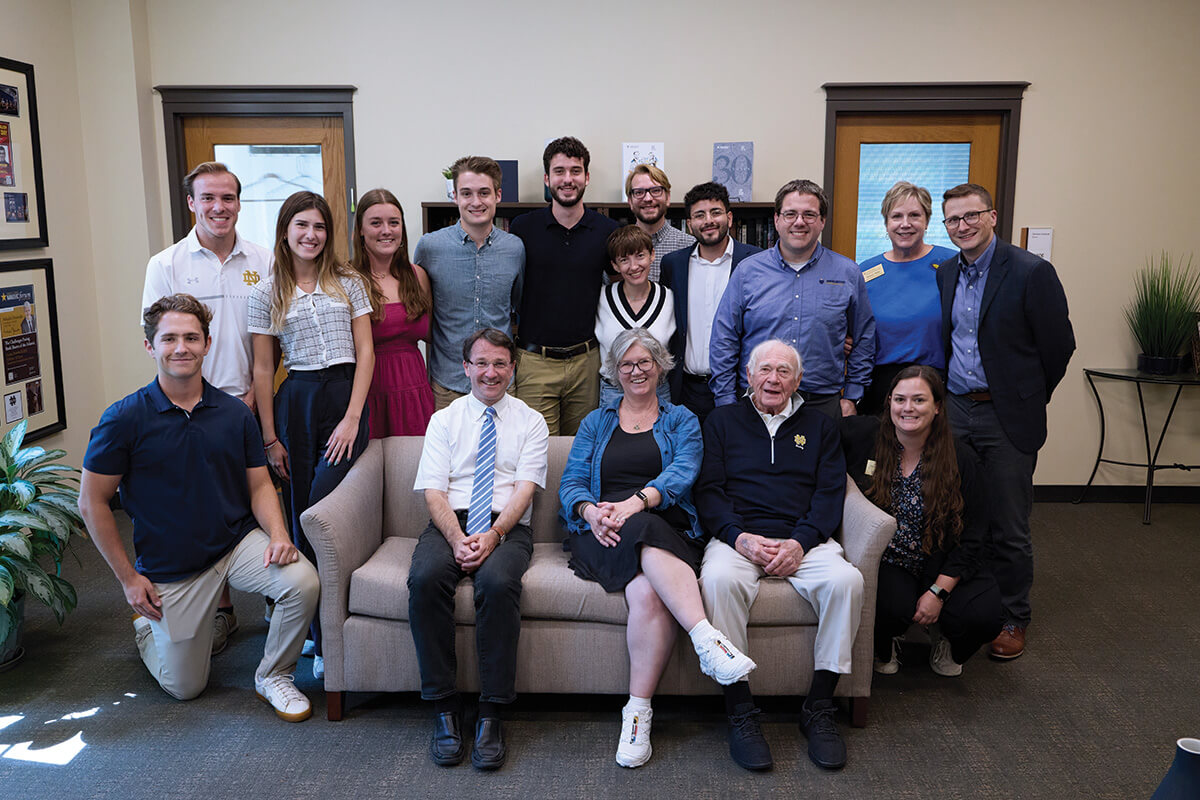
<figure class="image image-default"><img src="https://nanovic.nd.edu/assets/631478/fullsize/bob_students.jpg" alt="Group photo of thirteen people posing in a room, including Bob Nanovic. Three people sit on a couch, while others stand and kneel around them. Some wear Notre Dame apparel." width="1200" height="800">
<figcaption>Robert Nanovic and Becky Nanovic come together with students and staff at the Nanovic Institute during their visit in fall 2024.</figcaption>
</figure>
<p>As the public debut of the Ukrainian Studies Hub, this event will have an enduring legacy. In her address, <a href="https://www.siue.edu/artsandsciences/political-science/faculty/wilson.shtml">Sophia Wilson</a>, president of the American Association for Ukrainian Studies, described the importance of the Hub:</p>
<figure class="image image-right"><img src="https://nanovic.nd.edu/assets/631474/sophia_wilson_web.jpg" alt="Black and white sketch of a woman with a chin-length bob haircut, Sophia Wilson, against a teal watercolor background. She is smiling and wearing a necklace." width="600" height="600">
<figcaption>Sophia Wilson. Portrait by Anastassia Cassady.</figcaption>
</figure>
<blockquote>“This is where people are going to learn more about Ukraine, and support the idea, as Ukrainians do, that justice and human rights matter. And that’s what we all need to fight for.”</blockquote>
<p>In addition to the feature on the conference, this issue of the Year in Review shares student stories, faculty achievements, research projects and outcomes, collaborations with both international partners and other Notre Dame units, and the many opportunities facilitated by the Nanovic Institute throughout the 2024-25 academic year to discuss important issues and topics facing Europe and the world. It highlights the institute’s reach across a wide geographic range of Europe—from restorative justice lessons learned in Norway to critical statistical work that will impact human lives in Malta, and much more—and an equally broad set of disciplines, including art, literature, history, political science, sustainability, anthropology, film, and others.</p>
<p>In his closing letter, <a href="https://nanovic.nd.edu/people/clemens-sedmak/">Clemens Sedmak</a>, director of the Nanovic Institute and professor of social ethics at the Keough School, suggested that “any deep community is both a community of memory and a community of hope. Our institute will make an effort to strengthen the hope of our students that this world can be transformed.”</p>
<p>This issue of the Year in Review features artwork by <a href="https://www.instagram.com/cassadytess/?hl=en">Anastassia Cassady</a>, a South Bend-based artist of Ukrainian heritage. In addition to painting the artwork on the cover, four featured profiles, and within the conference story, Cassady also wrote the icon of the Theotokos, now in Lviv, Ukraine, presented to Archbishop Borys Gudziak, Metropolitan-Archbishop of the Ukrainian Catholic Archeparchy of Philadelphia and president of Ukrainian Catholic University, during the conference.</p>
<p class="attribution">Originally published by <span class="rel-author">Keith Sayer</span> at <span class="rel-source"><a href="https://nanovic.nd.edu/news/nanovic-institutes-2024-25-year-in-review-celebrates-the-ukrainian-studies-hub-and-its-inaugural-conference/">nanovic.nd.edu</a></span> on <span class="rel-pubdate">September 26, 2025</span>.</p>]]>
    </content>
    <link rel="enclosure" type="image/jpeg" href="https://crossingthesquare.nd.edu/assets/633019/webthumbnail.jpg" title="Nanovic Institute for European Studies Year in Review 2024-2025 cover featuring drawings of three individuals above a field of wheat and, beside it, an icon of Mary holding baby Jesus."/>
    <author>
      <name>Keith Sayer</name>
    </author>
  </entry>
  <entry>
    <id>tag:crossingthesquare.nd.edu,2005:News/175433</id>
    <published>2025-09-23T12:00:00-04:00</published>
    <updated>2025-10-02T10:01:19-04:00</updated>
    <link rel="alternate" type="text/html" href="https://crossingthesquare.nd.edu/articles/flta-spotlight-alina-boiko/"/>
    <title>FLTA Spotlight: Alina Boiko</title>
    <summary type="text">
      <![CDATA[As a Fulbright language teaching assistant, rightly speaking Alina Boiko is not a professor. However, “Professor Boiko” is how many of her students address her, and Alina realizes she quite likes the sound of it. Alina grew up in the Kharkiv State in Ukraine, before moving to Kyiv to study…]]>
    </summary>
    <content type="html">
      <![CDATA[<p>As a Fulbright language teaching assistant, rightly speaking Alina Boiko is not a professor. However, “Professor Boiko” is how many of her students address her, and Alina realizes she quite likes the sound of it.</p>
<p>Alina grew up in the Kharkiv State in Ukraine, before moving to Kyiv to study at the National Universtiy of Kyiv–Moyhla Academy, where she earned her BA. She studied there on a full scholarship, courtesy of high performance on an assessment of her academic skills, where her knowledge of Ukrainian language and literature gave her a real advantage. Alina was initially inspired by a tentative thought of becoming a tutor for Ukrainian teens, to help afford them the same opportunity she had been given. So at Kyiv–Moyhla she began studying Ukrainian Language and Literature, to one day teach those very subjects to young secondary students like her.</p>
<p>When she first began, her field of study was relatively niche. “It was not considered a prestigious field,” Alina explains. But as her education continued, that changed. Many more people are interested in learning the Ukrainian language and its literature, for some as a way of showing national pride. Alina’s study of Ukrainian Language and Literature is a philological one, having to do with their respective developments and the relationship between them and other cultures and languages. Alina completed several theses, one being a comparative study of Ukrainian immigrant literature and Chinese immigrant literature, and another being the phonetic deviations of those for whom Ukrainian is a second language.</p>
<p>When applying to be a Fulbright scholar, Alina was in just her third year of study. <em>“Too young,”</em> some of her peers would say, or <em>“too inexperienced.”</em> <em>“You’ll never get it.”</em></p>
<p>But none of this dissuaded Alina. “You don’t have to have the whole road to take the first step,” she says, but “every step you take is leading you to something great.” She has immense gratitude for the professors and the faculty of Kyiv–Moyhla for believing in and supporting her throughout the Fulbright scholar application process, which took almost a year to complete. Her hard work and dedication paid off, and Alina was accepted to be a Fulbright Foreign Language Teaching Assistant at the Univeristy of Notre Dame, scheduled to move abroad for a year, just months after she graduated from Kyiv–Moyhla.</p>
<p>Alina has just been in South Bend for four weeks, but already she is filled with gratitude and hope. Alina has a great respect for every student she has who wants to learn Ukrainian. “It’s hard; it’s humbling,” Alina says. She studied abroad at the University of Toronto for a semester while at Kyiv–Moyhla, and recalls having real difficulties with her English. She relied on her community of other students from Kyiv–Moyhla, but that also made it easier to limit the English she spoke to classtime.</p>
<p>“It was a lot of hard work,” Alina says, to get where she is with the English language now. “A foreign language, with different letters…it’s inherently outside your comfort zone.” Grateful that there are people who ventured into her one-credit language course, Alina is also proud to share that next semester Notre Dame will offer a full beginning language course for Ukrainian – three-credits and applicable to language requirements and such. Alina is excited, and hopes more people take the leap and join her to learn Ukrainian “from the beginning.”</p>
<p>Alina has been sharing her own story for nine years through her Study Blog, which has documented her life’s trajectory in Ukrainian since she was in the 8th grade. Her readers, knowing her from a school-girl age, are just as thrilled as Alina at the honorary title of “Professor Boiko.” When asked about her future goals, Alina is thinking about further education, to better determine what she likes and doesn’t like and figure out where she wants to be. But she reminds us, her readers today, that although her Study Blog shows a straight path from the 14-year-old in her own hometown to a language teacher in a new country, at no point on that road did that girl know where she was headed. “We do not know what will happen tomorrow,” Alina says, but we don’t need to. Her dream of tutoring Ukrainian teens has certainly evolved and expanded. Alina will definitely become “Professor Boiko” for real someday, dedicated to educational and Ukrainian studies. Wherever she goes, she’s headed somewhere great.</p>
<p><em>About the CSLC</em></p>
<p><em>The Center for the Study of Languages and Cultures (CSLC) aims to support language learners at ND by facilitating meaningful experiences with linguistic acquisition and exchange - both in our campus community and abroad. We believe that access to the world's languages and cultures allows us to seek out new perspectives, to value the diversity of the world's cultures, and to embody global citizenship.</em></p>
<p> </p>
<p class="attribution">Originally published by <span class="rel-author">Lucy Florenzo</span> at <span class="rel-source"><a href="https://cslc.nd.edu/news-and-events/news/flta-spotlight-alina-boiko/">cslc.nd.edu</a></span> on <span class="rel-pubdate">September 23, 2025</span>.</p>]]>
    </content>
    <link rel="enclosure" type="image/jpeg" href="https://crossingthesquare.nd.edu/assets/633006/img_9693_optimized_2000.jpeg" title="Alina Boiko"/>
    <author>
      <name>Lucy Florenzo</name>
    </author>
  </entry>
  <entry>
    <id>tag:crossingthesquare.nd.edu,2005:News/175434</id>
    <published>2025-09-17T12:00:00-04:00</published>
    <updated>2025-10-02T10:01:48-04:00</updated>
    <link rel="alternate" type="text/html" href="https://crossingthesquare.nd.edu/articles/ukrainian-studies-hub-grant-program-offers-funding-for-ukraine-focused-research-at-notre-dame/"/>
    <title>Ukrainian Studies Hub Grant program offers funding for Ukraine-focused research at Notre Dame</title>
    <summary type="text">
      <![CDATA[In 2024, the Nanovic Institute for European Studies, part of the University of Notre Dame’s Keough School of Global Affairs, launched the Ukrainian…]]>
    </summary>
    <content type="html">
      <![CDATA[<p>In 2024, the <a href="https://nanovic.nd.edu/">Nanovic Institute for European Studies</a>, part of the University of Notre Dame’s <a href="https://keough.nd.edu/">Keough School of Global Affairs</a>, launched the <a href="https://nanovic.nd.edu/grants/faculty/ukrainian-studies-hub-research-grant/">Ukrainian Studies Hub Research Grant program</a>. Open to all Notre Dame faculty, and especially those collaborating with colleagues from Ukrainian Catholic University (UCU), these grants support research focused on Ukraine and Ukrainian studies.</p>
<p>Several proposals have already been successful since the program launched, including:</p>
<ul>
<li>
<p><strong>“Student stories of resilience and resistance: Training UCU students in documentary film making in collaborative UCU-ND masterclasses,” </strong>led by:</p>
</li>
<ul>
<li>
<p><a href="https://anthropology.nd.edu/people/faculty/ian-kuijt/">Ian Kuijt</a>, professor of anthropology</p>
</li>
<li>
<p><a href="https://nanovic.nd.edu/people/visiting-scholars/andrii-shestak/">Fr. Andrii Shestak</a>, director of the School of Journalism and Communication (UCU)</p>
</li>
</ul>
<li dir="ltr" aria-level="1">
<p><strong>“How the war has disrupted our thinking: Philosophy in Ukraine after ten years of Russian aggression (2014–2024),”</strong> led by:</p>
</li>
<ul>
<li dir="ltr" aria-level="2">
<p><a href="https://nanovic.nd.edu/people/clemens-sedmak/">Clemens Sedmak</a>, professor of social ethics</p>
</li>
<li dir="ltr" aria-level="2">
<p><a href="https://ac.ucu.edu.ua/persons/turchynovskyj-volodymyr/">Volodymyr Turchynovskyy</a>, dean of the Faculty of Social Sciences (UCU)</p>
</li>
</ul>
<li dir="ltr" aria-level="1">
<p><strong>“Hromada: A Documentary Short Film on the Ukrainian War Refugees in Georgia,” </strong>led by <a href="https://ftt.nd.edu/people/faculty/george-sikharulidze/">George Sikharulidze</a>, associate professor of film production.</p>
</li>
<li dir="ltr" aria-level="1">
<p><strong>“Hope in Action: Exploring Ukrainian Educators’ Understanding, Cultivation, and Enactment of Hope Within War,”</strong> led by:</p>
</li>
<ul>
<li dir="ltr" aria-level="2">
<p><a href="https://mendoza.nd.edu/mendoza-directory/profile/jessica-mcmanus-warnell/">Jessica McManus Warnell</a>, teaching professor and Rex and Alice A. Martin Faculty Director of the <a href="https://ethicalleadership.nd.edu/">Notre Dame Deloitte Center for Ethical Leadership</a></p>
</li>
<li dir="ltr" aria-level="2">
<p><a href="https://ucu.edu.ua/en/administration/sofiya-opatska/">Sophia Opatska</a>, vice-rector of strategic development (UCU)</p>
</li>
<li dir="ltr" aria-level="2">
<p><a href="https://bond.edu.au/profile/amy-kenworthy">Amy Kenworthy</a>, professor of management (Bond University)</p>
</li>
</ul>
<li dir="ltr" aria-level="1">
<p><strong>“Civic Relations in Early Modern Lviv: A Digital Reconstruction of Social Networks,”</strong> led by:</p>
</li>
<ul>
<li dir="ltr" aria-level="2">
<p><a href="https://engineering.nd.edu/faculty/tim-weninger/">Tim Weninger</a>, associate professor of computer science and engineering</p>
</li>
<li dir="ltr" aria-level="2">
<p><a href="https://ukrainiancatholic.academia.edu/OrysyaVira">Orysia Vira</a>, lecturer in the Department of History (UCU)</p>
</li>
<li dir="ltr" aria-level="2">
<p><a href="https://apps.ucu.edu.ua/en/teachers/andriy-hrynykha/">Andriy Hrynykha</a>, project and program manager, communications manager in the Faculty of Applied Sciences (UCU)</p>
</li>
<li dir="ltr" aria-level="2">
<p><a href="https://apps.ucu.edu.ua/en/oles-dobosevych/">Oles Dobosevych</a>, deputy dean of the Faculty of Applied Sciences (UCU)</p>
</li>
</ul>
</ul>
<p>This program is administered through the institute’s <a href="https://nanovic.nd.edu/about/ukrainian-studies-hub/">Ukrainian Studies Hub</a> initiative, which was officially inaugurated March 6–8, 2025, with the global conference <a href="https://nanovic.nd.edu/events/2025-ukrainian-studies-conference">“Revolutions of Hope: Resilience and Recovery in Ukraine.”</a></p>
<p>Regarding the program, Clemens Sedmak, director of the Nanovic Institute, said, “The Ukrainian Studies Hub Research grants allow us to support and enhance the level of scholarship about Ukraine across campus and around the world.” He added, “This is the core of the mission of the Ukrainian Studies Hub. We are already seeing excellent and insightful projects come through, and I am particularly excited to see further collaboration generated between Notre Dame and Ukrainian Catholic University.”</p>
<p>In the 2025-26 academic year, the institute has committed to continuing this grant program with additional leadership and guidance from <a href="https://nanovic.nd.edu/people/rory-finnin/">Rory Finnin</a>, professor of Ukrainian studies at the University of Cambridge and visiting professor at Notre Dame. Any Notre Dame faculty member with an eligible research project may submit a proposal. Applications are open and will be evaluated on a rolling basis.</p>
<p><a href="http://nanovicnd.submittable.com/submit/301464/nanovic-faculty-grant-application" class="btn btn-cta">Start an Application</a></p>
<p>The Ukrainian Studies Hub will also host its first public event of the 2025-26 academic year on Friday, September 26, 2025, 3:30–4:30 p.m. in 1050 Jenkins Nanovic Hall. Finnin will offer a lecture titled <a href="https://nanovic.nd.edu/events/2025/09/26/chornobyl-madonna-catastrophe-and-hope-in-ukraine-and-the-collapse-of-the-soviet-union/">“Chornobyl Madonna: Catastrophe and Hope in Ukraine and the Collapse of the Soviet Union.”</a> A short reception will follow.</p>
<figure class="image image-default"><a href="https://nanovic.nd.edu/events/2025/09/26/chornobyl-madonna-catastrophe-and-hope-in-ukraine-and-the-collapse-of-the-soviet-union/"><img src="https://nanovic.nd.edu/assets/630595/nan_horz_chornobyl_sept27.jpg" alt='Flyer for a lecture titled "Chornobyl Madonna: Catastrophe and Hope in Ukraine and the Collapse of the Soviet Union." Rory Finnin, professor of Ukrainian studies at Cambridge, will speak on September 26, 2025, at 3:30 p.m. in 1050 Jenkins Nanovic Halls at Notre Dame. The flyer features a photo of Finnin and the Chernobyl Nuclear Power Plant.  The event is sponsored by the Nanovic Institute for European Studies.' width="600" height="338"></a></figure>
<p class="attribution">Originally published by <span class="rel-author">Keith Sayer</span> at <span class="rel-source"><a href="https://nanovic.nd.edu/news/ukrainian-studies-hub-grant-program-offers-funding-for-ukraine-focused-research-at-notre-dame/">nanovic.nd.edu</a></span> on <span class="rel-pubdate">September 17, 2025</span>.</p>]]>
    </content>
    <link rel="enclosure" type="image/jpeg" href="https://crossingthesquare.nd.edu/assets/633007/copy_of_linkedin_or_x_post_no_photo_1200_x_800_px_1_.jpg" title="Ukrainian Studies Hub Grant Program, sponsored by the Nanovic Institute for European Studies at the Keough School of Global Affairs."/>
    <author>
      <name>Keith Sayer</name>
    </author>
  </entry>
  <entry>
    <id>tag:crossingthesquare.nd.edu,2005:News/175432</id>
    <published>2025-08-22T09:59:00-04:00</published>
    <updated>2025-10-02T09:59:46-04:00</updated>
    <link rel="alternate" type="text/html" href="https://crossingthesquare.nd.edu/articles/relying-and-acting-on-hope-celebrating-ukraines-independence-day/"/>
    <title>Relying and acting on hope: Celebrating Ukraine’s Independence Day</title>
    <summary type="text">
      <![CDATA[On the occasion of Ukraine’s Independence Day, the Nanovic Institute for European Studies shares below the reflections of Taras Dobko, rector of Ukrainian Catholic University, about the 2025…]]>
    </summary>
    <content type="html">
      <![CDATA[<p><em>On the occasion of Ukraine’s Independence Day, the Nanovic Institute for European Studies shares below the reflections of Taras Dobko, rector of <a href="https://ucu.edu.ua/en/">Ukrainian Catholic University</a>, about the <a href="https://nanovic.nd.edu/events/2025-ukrainian-studies-conference">2025 Ukrainian Studies Conference at Notre Dame</a>. On this day, the institute remembers its friends in Ukraine and the work we are doing together. The links and videos below provide additional ways to connect with Ukraine through art and scholarship. A version of this text will also be included in a feature story in the forthcoming Nanovic Institute Year in Review 2024-25.</em></p>
<p>The March 2025 conference “Revolutions of Hope: Resilience and Recovery in Ukraine” was a fascinating and beautiful experience. It officially inaugurated the <a href="https://nanovic.nd.edu/about/ukrainian-studies-hub">Ukrainian Studies Hub</a> at the Nanovic Institute for European Studies, and so it was, fittingly, an invaluable academic exchange of ideas. However, it was also filled with artistic celebration, making friends, and praying together.</p>
<p><iframe width="560" height="315" src="https://www.youtube.com/embed/sMnYymM5PbU?si=QLQGv2OSj4P2rsgq&amp;start=2751" title="YouTube video player" frameborder="0" allow="accelerometer; autoplay; clipboard-write; encrypted-media; gyroscope; picture-in-picture; web-share" referrerpolicy="strict-origin-when-cross-origin" allowfullscreen="allowfullscreen"></iframe></p>
<p>Our conference brought a lot of hope to rely on and to act on. Let me offer a linguistic observation from the Ukrainian language. The equivalent of the English word “reliable” in Ukrainian is “надійний,” related to the word “надія” (“hope”), which itself includes the term “дія” (“action”). Thus, the very language of Ukraine teaches us that we can rely on hope and act on its promises.</p>
<p>We had so many signs and testimonies of hope during this conference.</p>
<p>Many of these sessions reminded me of my lived experience in Ukraine. In Lviv, at least three art galleries have opened during the past few years. Likewise, it has been difficult to get a ticket for a theatre performance during the war because they are sold out. New bookstores are being opened because the book industry is thriving. These are just a few signs of hope I see.</p>
<div class="grid grid-md-2 grid-xl-4">
<div class="card hover-bg">
<p class="card-image"><img src="https://nanovic.nd.edu/assets/552760/word_600x400.jpg" alt="Words by Kateryna Kosianenko" width="600" height="400"></p>
<div class="card-body">
<h2 class="card-title"><a class="card-link" href="https://go.nd.edu/ukrainewriting">Writing the War in Ukraine</a></h2>
<p>A joint project between Notre Dame and UCU students studying Ukrainian wartime poetry and songs.</p>
</div>
</div>
<div class="card hover-bg">
<p class="card-image"><img src="https://nanovic.nd.edu/assets/510128/chris_shaw_saint_javelin_painting_2022_600x400.jpg" alt="Saint Javelin by Chris Shaw" width="600" height="400"></p>
<div class="card-body">
<h2 class="card-title"><a class="card-link" href="https://go.nd.edu/ukrainianart">Ukrainian Art as Protest and Resilience</a></h2>
<p>A digital art exhibition and analyses by students from Notre Dame and UCU.</p>
</div>
</div>
</div>
<p><em>The links above lead to digital exhibitions of two undergraduate research projects that explored both written and visual Ukrainian art.</em></p>
<p>During this conference, we also heard that we need a politics of hope, which is essentially politics based on Catholic Social Teaching and grounded in Christian values. It is my conviction that in the present adverse circumstances, Ukrainians of different social status, ethnic origin, and religious allegiance manage to survive and even look beyond survival for development only to the extent that they intuitively adhere to the CST principles of dignity, solidarity, subsidiarity (agency), and common good.</p>
<blockquote class="pull">
<p>Ukrainian youth perceive freedom, justice, and dignity as inseparably connected with their human flourishing.</p>
</blockquote>
<p>I am also very concerned about Ukrainians adopting a victim-based identity as a result of accepting an unjust peace deal. Regrettably, many people may already feel betrayed, but I think a politics of hope can be an antidote against this development. It is the opposite of a politics of grievances.</p>
<p>We witnessed this politics of hope in action in late July when young Ukrainians in many cities rallied in defense of the independence of key anti-corruption agencies and with the requirement to follow due procedures in passing resolutions which could affect the ascension of Ukraine to the EU. These events demonstrated that the democratic spirit in the youngest generation is strong and alive, and that they are ready to defend democracy both from external aggressors and “home-made” autocrats. Ukrainian youth perceive freedom, justice, and dignity as inseparably connected with their human flourishing.</p>
<p><iframe width="560" height="315" src="https://www.youtube.com/embed/a-a5IHX3d10?si=YbsK0NB504Tr3gIa&amp;start=3768" title="YouTube video player" frameborder="0" allow="accelerometer; autoplay; clipboard-write; encrypted-media; gyroscope; picture-in-picture; web-share" referrerpolicy="strict-origin-when-cross-origin" allowfullscreen="allowfullscreen"></iframe></p>
<p>This conference will have an ongoing legacy. There is already a program that accepts proposals for joint faculty research projects between Notre Dame and UCU faculty members with the potential to achieve international recognition and generate sustainable research outcomes.</p>
<p>This research will have much to teach us about what makes democracies resilient and how religion can play a role. For Ukraine, this is most timely. As we work toward a hopeful future, we must also plan for how to address individual and collective trauma and how to achieve physical, moral, and religious healing. The Ukrainian Studies Hub and the partnership between Notre Dame and Ukrainian Catholic University will demonstrate that the Ukrainian experience is an essential voice and example for addressing these same issues globally.</p>
<p>We are generating a model for Ukrainian studies. As we continue supporting individual Ukrainian scholars displaced by war, we are also cultivating academic collaboration to design a joint, long-term research program with a world-class profile and potential. I am grateful to Notre Dame for joining us in crafting this example, which will be invaluable for the future of Ukrainian academia and Ukrainian studies worldwide.</p>
<p><a href="https://nanovic.nd.edu/events/2025-ukrainian-studies-conference/videos/" class="btn btn-cta">Watch the conference sessions</a></p>
<p class="attribution">Originally published by <span class="rel-author">Taras Dobko</span> at <span class="rel-source"><a href="https://nanovic.nd.edu/news/relying-and-acting-on-hope-celebrating-ukraines-independence-day/">nanovic.nd.edu</a></span> on <span class="rel-pubdate">August 22, 2025</span>.</p>]]>
    </content>
    <link rel="enclosure" type="image/jpeg" href="https://crossingthesquare.nd.edu/assets/633005/pr_30825_nanovic_ukrainian_studies_conference_620.jpg" title="Taras Dobko in a suit and tie gestures while speaking at a clear podium in front of an audience.  A banner for the Nanovic Institute for European Studies stands beside him, and a small bouquet of yellow flowers sits on a table in front of the podium."/>
    <author>
      <name>Taras Dobko</name>
    </author>
  </entry>
  <entry>
    <id>tag:crossingthesquare.nd.edu,2005:News/175435</id>
    <published>2025-08-21T12:00:00-04:00</published>
    <updated>2025-10-02T10:02:19-04:00</updated>
    <link rel="alternate" type="text/html" href="https://crossingthesquare.nd.edu/articles/hesburgh-library-to-be-illuminated-in-solidarity-for-ukraines-independence-day/"/>
    <title>Hesburgh Library to be illuminated in solidarity for Ukraine’s Independence Day</title>
    <summary type="text">
      <![CDATA[In observance of Ukraine’s Independence Day, the Hesburgh Library at the University of Notre Dame will be illuminated in Ukrainian blue and yellow on the evening of Sunday, August 24, 2025. This is the date on which the Act of Declaration of Independence of Ukraine was issued in 1991. While…]]>
    </summary>
    <content type="html">
      <![CDATA[<p>In observance of Ukraine’s Independence Day, the Hesburgh Library at the University of Notre Dame will be illuminated in Ukrainian blue and yellow on the evening of Sunday, August 24, 2025. This is the date on which the Act of Declaration of Independence of Ukraine was issued in 1991.</p>
<p>While the date would always be meaningful, during the ongoing full-scale invasion of Ukraine by Russia that began on February 24, 2022, this date holds even greater significance. Illuminating the Hesburgh Library in the colors of the Ukrainian flag is a visible symbol of the University of Notre Dame’s solidarity with the people of Ukraine.</p>
<p>Shortly following the beginning of Russia’s invasion, then-University President Rev. John I. Jenkins, C.S.C., issued a <a href="https://news.nd.edu/news/notre-dame-president-rev-john-i-jenkins-c-s-c-on-russian-invasion-of-ukraine/">statement</a>:</p>
<p style="padding-left: 40px;">“We at Notre Dame stand in solidarity with all peace-loving people worldwide in demanding an end to this invasion of a sovereign nation. This unprovoked war is an international abomination and must stop now. Until it does, may God keep safe all of the innocent men, women, and children who are currently in harm’s way. The prayers of the Notre Dame family are with them.”</p>
<p>This commitment was affirmed on March 6, 2025, when University President Rev. Robert A. Dowd, C.S.C., said, “Let me be perfectly clear here today. We here at Notre Dame stand with the people of Ukraine and offer them our full support.” Father Dowd was speaking at the international conference, “<a href="https://go.nd.edu/ukrainehope">Revolutions of Hope: Resilience and Recovery in Ukraine</a>,” which also served as the public launch of Notre Dame’s <a href="https://nanovic.nd.edu/about/ukrainian-studies-hub">Ukrainian Studies Hub</a>, an interdisciplinary initiative led by the Keough School’s <a href="https://nanovic.nd.edu">Nanovic Institute for European Studies</a> to promote the study of Ukraine across campus and around the world.</p>
<p><a href="https://nanovic.nd.edu/people/clemens-sedmak/">Clemens Sedmak</a>, director of the Nanovic Institute and professor of social ethics at the <a href="https://keough.nd.edu">Keough School of Global Affairs</a>, said, “Ukraine is the name of a country, but it also stands for resilience and a fight for freedom and independence. We have a strong partner in the Ukrainian Catholic University (Lviv, Ukraine), and our friends there teach us a lot about how to prepare students for a life of service and how to model a commitment to dignity and a willingness to sacrifice.“</p>
<p>During the 2025-26 academic year, the Nanovic Institute is hosting <a href="https://nanovic.nd.edu/people/visiting-scholars/rory-finnin">Rory Finnin</a>, professor of Ukrainian Studies at the University of Cambridge and recipient of the 2024 Laura Shannon Prize in Contemporary European Studies, who said, “At Notre Dame, we ask, ‘What would you fight for?’ The people of Ukraine remind us that they fight not only for independence, but for their very existence and dignity. Lighting a space of knowledge in the colors of the Ukrainian flag signals our solidarity with them and our hope in a just peace.”</p>
<p>In addition to the illumination of the Hesburgh Library, Ukraine’s Independence Day will also be observed by the Nanovic Institute through a <a href="https://nanovic.nd.edu/news-and-media/">forthcoming story</a> by Taras Dobko, rector of Ukrainian Catholic University, and by the display of prints by Ukrainian photographer Iva Sidash and a message from Ukrainain Catholic University in its office suite.</p>
<p class="attribution">Originally published by <span class="rel-author">Keith Sayer</span> at <span class="rel-source"><a href="https://nanovic.nd.edu/news/hesburgh-library-to-be-illuminated-in-solidarity-for-ukraines-independence-day/">nanovic.nd.edu</a></span> on <span class="rel-pubdate">August 21, 2025</span>.</p>]]>
    </content>
    <link rel="enclosure" type="image/jpeg" href="https://crossingthesquare.nd.edu/assets/633008/mc_31822_library_ukraine.jpg" title="At night, the Word of Life mural on Hesburgh Library glows blue and yellow.  People sit at tables and lounge chairs on the lawn in front."/>
    <author>
      <name>Keith Sayer</name>
    </author>
  </entry>
  <entry>
    <id>tag:crossingthesquare.nd.edu,2005:News/175438</id>
    <published>2025-07-02T12:00:00-04:00</published>
    <updated>2025-10-02T10:02:55-04:00</updated>
    <link rel="alternate" type="text/html" href="https://crossingthesquare.nd.edu/articles/notre-dame-announces-new-research-collaborations-with-ukrainian-catholic-university/"/>
    <title>Notre Dame announces new research collaborations with Ukrainian Catholic University</title>
    <summary type="text">
      <![CDATA[Seven faculty teams of collaborators from the University of Notre Dame (South Bend, Indiana, USA) and Ukrainian Catholic University (Lviv, Ukraine) have received grants from Notre Dame Global and Notre Dame Research to pursue…]]>
    </summary>
    <content type="html">
      <![CDATA[<p>Seven faculty teams of collaborators from the University of Notre Dame (South Bend, Indiana, USA) and Ukrainian Catholic University (Lviv, Ukraine) have received grants from <a href="https://global.nd.edu/">Notre Dame Global</a> and <a href="https://research.nd.edu/">Notre Dame Research</a> to pursue research on pertinent issues in Ukraine. The grants provide support for projects related to ethical infrastructure and leadership for resilient democracies, data science for the common good, religious freedom, collective trauma and collective healing, the mental health of veterans, and the moral and religious dimension of security in the war-stricken country. Many of the projects, in addition to bringing together colleagues from both universities, span multiple departments within each university.</p>
<p>The research partnerships enabled by this grant program strengthen the relationship between these two Catholic institutions, <a href="https://news.nd.edu/news/the-bonds-between-notre-dame-and-ukraine/">a bond</a> established more than two decades ago. In 2004, just after the Ukrainian Catholic University (UCU) was founded as the first Catholic university on territory of the former Soviet Union, the <a href="https://nanovic.nd.edu/about/catholic-universities-partnership/">Catholic Universities Partnership</a> was formed under the leadership of Notre Dame’s <a href="https://nanovic.nd.edu/">Nanovic Institute for European Studies</a>, bringing together nine European institutions including UCU for research, leadership and visiting scholars programs.</p>
<p>Just months after the full-scale Russian invasion of Ukraine in 2022, Rev. John I. Jenkins, C.S.C., then-president of Notre Dame, and Metropolitan-Archbishop Borys Gudziak, organizer and president of Ukrainian Catholic University, <a href="https://global.nd.edu/news-stories/news/standing-in-solidarity-notre-dame-expands-partnership-with-ukrainian-catholic-university/">agreed to expand the existing partnership</a> between Notre Dame and UCU. Part of the expansion is the distribution of grants for faculty at both universities to pursue joint research projects and <a href="https://nanovic.nd.edu/news/a-laboratory-for-social-innovation-resilience-and-recovery-in-ukraine/">nurture ongoing collaboration</a>.</p>
<p>“At a critical moment in Ukraine’s history, the commitment between our two universities is a testament to our Catholic mission and identity,” said Michael Pippenger, Notre Dame <a href="https://global.nd.edu/about/people/michael-pippenger/">vice president &amp; associate provost for internationalization</a>. “These research collaborations advance our mutual research priorities for the common good, bringing together our faculty and students, which is a great investment in our shared future.”</p>
<p>"This collaboration between our universities offers a unique opportunity to jointly address some of the most pressing challenges of our time," said Yaroslav Prytula, <a href="https://ucu.edu.ua/en/administration/yaroslav-prytula/">Ukrainian Catholic University provost</a>. "It is not only an act of solidarity but a shared mission to shape ethical leadership, rebuild democratic resilience, and contribute to the common good."</p>
<p>The 2025 awardees of the <a href="https://global.nd.edu/faculty-research/grants-and-funding/university-of-notre-dame-ukrainian-catholic-university-faculty-collaboration-grant-program/">ND - UCU Faculty Collaboration Grant</a> are described below.</p>
<p>Yury P. Avvakumov and Oleh Turiy will lead a study titled “Religious Freedom in Contemporary Ukraine: Historical Transformations and the Challenges of War.” Avvakumov, an associate professor in Notre Dame’s <a href="http://theology.nd.edu">Department of Theology</a>, will be joined by Sean Griffin, an associate professor of <a href="https://germanandslavic.nd.edu/">Slavic, and Eurasian Studies</a>. Turiy, head of the <a href="https://ich.ucu.edu.ua/">Institute of Church History</a> at UCU, will work with associate professor Svitlana Hurkina and Myroslav Marynovych, president of UCU’s Institute of Religion and Society. The researchers will examine the re-emergence of the Greek Catholic Church and new religious denominations established in Ukraine during the late Soviet period, drawing on official state documents and government records, as well as newspapers, personal letters, interviews and photographs. The research team is especially interested in the interactions between Christian denominations, and the relationship between church and state situated within the changing social and political landscape of the late 20th century.</p>
<p>E. Mark Cummings and Oleksandr Avramchuk will lead a study titled “The adaptation and pilot testing of the Promoting a Positive Family Future (PPFF) intervention for veteran families in Ukraine.” Cummings, the William J. Shaw Family Professor in Notre Dame’s <a href="http://psychology.nd.edu">Department of Psychology</a> and director of the <a href="https://fsl.nd.edu/">Family Studies Lab</a>, will be joined by Kathleen N. Bergman, psychology research assistant professor, Sarah (Hoegler) Dennis, postdoctoral scholar in the <a href="http://anthropology.nd.edu">Department of Anthropology</a>, and Reyhaneh Sadat Razavi, psychology graduate student. Avramchuk, head of UCU’s <a href="https://fhs.ucu.edu.ua/en/">Department of Clinical Psychology - Faculty of Health Science</a>, will be joined by Oksana Senyk, lecturer in the <a href="https://psychology.ucu.edu.ua/">Department of Psychology and Psychotherapy</a>, and Kristina Obluchynska-Shabazova, lecturer in the <a href="https://cbt.ucu.edu.ua/">Department of Clinical Psychology</a> at UCU. The researchers will explore how psychological trauma affects the family dynamic of Ukrainian veterans when they return to civilian life after war. The initial phase will consist of focus groups and interviews with veterans and their families to analyze mental states and family dynamics. With the goal of collective healing in mind, the project ultimately aims to adapt the psychosocial intervention program <a href="https://kellogg.nd.edu/news/miller-graff-collaborates-develop-support-program-palestinians-impacted-violence-gaza-west-bank">Promoting Positive Family Futures (PPFF)</a> for Ukrainian families.</p>
<p>Alan Huebner, teaching professor in Notre Dame’s <a href="http://acms.nd.edu">Department of Applied and Computational Mathematics and Statistics</a>, will collaborate with Tetiana Zakharchenko, program director of computer science in UCU’s <a href="http://apps.ucu.edu.ua">Faculty of Applied Sciences</a>, to head a study titled “Lost Knowledge: A Data-Driven Study of K-12 Math Learning in Ukraine.” Rostyslav Hryniv, chair of <a href="http://apps.ucu.edu.ua">Applied Mathematics and Statistics</a> at UCU, and Inha Kozlova, associate professor in the UCU <a href="https://sociology.ucu.edu.ua/en/">Department of Sociology</a>, will serve as co-principal investigators. The researchers will investigate learning outcomes in math among K-12 Ukrainian students during recent years with the hope of providing guidance for educational recovery. The team will implement two approaches: quantitative analysis of multiple assessment results and interviews with students and math teachers to assess the qualitative impact of uncertainty on teaching and learning. The ultimate goal of the study is to advise schools on curriculum adjustments and supports to raise student performance in moving forward.</p>
<p>Debra Javeline, professor in Notre Dame’s <a href="http://politicalscience.nd.edu">Department of Political Science</a>, and Pavlo Khud, lecturer in the UCU Department of Management and Organizational Development, will pursue a project titled “Network Leadership for Democratic Resilience in Ukraine.” The pair will join Andriy Rozhdestvensky, executive director of the <a href="https://uculeadership.com.ua/en/">Center for Leadership</a> at UCU. Spanning policy advocacy, civic engagement, and organizational leadership, the team will study and evaluate social networks among leaders of non-governmental organizations that have played a critical role in sustaining Ukraine’s democratic values. By examining these leadership structures, researchers aim to identify best practices for strengthening democratic governance.</p>
<p>Rahul Oka, associate research professor in Notre Dame’s <a href="https://keough.nd.edu/">Keough School of Global Affairs</a> and the <a href="https://anthropology.nd.edu/">Department of Anthropology</a>, and Iryna Semkiv, associate professor in the <a href="https://psychology.ucu.edu.ua/">Department of Psychology and Psychotherapy</a> at UCU, will co-lead a project titled “Exploring the Built Environment to Understand Collective Trauma and the Potential of Community-Based Collective Healing in Ukraine.” They will join co-principal investigators Marianne Cusato, professor of the practice in the <a href="https://architecture.nd.edu/">School of Architecture</a>, Lee Gettler, the Rev. John A. O'Brien College <a href="https://anthropology.nd.edu/">Professor of Anthropology</a> and chair of the department, professor Roman Kechur and assistant professor Tetyana Zavada of UCU’s <a href="https://psychology.ucu.edu.ua/">Department of Psychology and Psychotherapy</a>, and Dmytro Myronovych, associate professor in the UCU <a href="https://sociology.ucu.edu.ua/en/">Department of Sociology</a>. This interdisciplinary team will investigate the connection between the use of public and private spaces and the psychosocial processes that affect physical and mental health. The project is particularly concerned with how the built environment may mitigate the trauma experienced by veterans and civilians by forging social bonds. More broadly, the project will aim to deliver policy recommendations to local officials and architects with adaptable best practices for rebuilding damaged Ukrainian communities with trauma recovery in mind.</p>
<p>Clemens Sedmak, director of Notre Dame’s <a href="http://nanovic.nd.edu">Nanovic Institute for European Studies</a>, will work with Volodymyr Turchynovskyy, dean of the <a href="https://fss.ucu.edu.ua/">Faculty of Social Sciences</a> and director of the <a href="https://iieci.ucu.edu.ua/en">International Institute for Ethics and Contemporary Issues</a> at UCU, to advance a collaborative historical and ethical study titled “The Moral Biography of Ukraine.” They will be joined by John Deak, associate professor in the <a href="http://history.nd.edu">Department of History</a>, A. James McAdams, emeritus faculty in the <a href="http://politicalscience.nd.edu">Department of Political Science</a>, Anatolii Babynskyi, professor in the <a href="https://ich.ucu.edu.ua/">Institute of Church History</a>, and Nataliya Yakymets, deputy director of research at UCU’s International Institute for Ethics and Contemporary Issues. The team plans to survey the systems that safeguard moral values in Ukraine by researching key moments in the nation’s history. These systems, together called ethical infrastructure, are crucial for upholding democracy and require continuous effort to maintain. The researchers will examine 15 episodes in the moral history of Ukraine since 1989 to identify where this ethical infrastructure has succeeded and failed to sustain human dignity and the common good.</p>
<p>Suzanne Shanahan and Rev. Yuriy Shchurko will head a project titled “Bringing a Just Peace to Ukraine.” Shanahan, Leo and Arlene Hawk Executive Director and professor of the practice at Notre Dame’s <a href="https://socialconcerns.nd.edu/">Institute for Social Concerns</a>, will be joined by colleagues Daniel Philpott, a professor in the <a href="https://politicalscience.nd.edu/">Department of Political Science</a>, and Gerard Powers, director of Catholic Peacebuilding Studies at the <a href="http://kroc.nd.edu">Kroc Institute</a>. Rev. Yuriy Martynyuk, senior professor of Theology, and Dmytro Tsolin, professor in the Department of Biblical Studies, will work alongside Shchurko, dean of the <a href="https://ptf.ucu.edu.ua/">Theology-Philosophy Faculty</a> at UCU. The project aims to establish a Center for Just Peace at UCU. The founding of the Center will follow a first phase of preliminary scholarship examining the Catholic theological approaches to peace, reconciliation after war, and the ideologies that power totalitarian governance. At the Center, the researchers envision continued research on building just peace in Ukraine, platforms for dialogue, and the development of educational programs for people in positions of power.</p>
<p>“The research enabled by this initiative will help to advance the safety, security, and well-being of those most impacted by the war in Ukraine, and pave avenues for the physical and cultural recovery of the nation,” said Jeffrey F. Rhoads, John and Catherine Martin Family Vice President for Research and Professor in the Department of Aerospace and Mechanical Engineering. “Notre Dame Research is pleased to honor the University’s commitment to our Ukrainian colleagues through these important research collaborations.”</p>
<p>To learn more about the Notre Dame-Ukrainian Catholic University Faculty Collaboration Grant Program, please visit <a href="https://global.nd.edu/faculty-research/grants-and-funding/university-of-notre-dame-ukrainian-catholic-university-faculty-collaboration-grant-program/">https://global.nd.edu/faculty-research/grants-and-funding/university-of-notre-dame-ukrainian-catholic-university-faculty-collaboration-grant-program/</a>.</p>
<p> </p>
<p><strong>Contact</strong></p>
<p>Erin Fennessy / Writing Program Manager</p>
<p>Notre Dame Research / University of Notre Dame</p>
<p>efenness@nd.edu / +1 574-631-8183</p>
<p>research.nd.edu / @UNDResearch / <a href="http://linkedin.com/company/undresearch">linkedin.com/company/undresearch</a></p>
<p><strong>About Notre Dame Research</strong></p>
<p>The University of Notre Dame is a private research and teaching university inspired by its Catholic mission. Located in South Bend, Indiana, its researchers are advancing human understanding through research, scholarship, education, and creative endeavor in order to be a repository for knowledge and a powerful means for doing good in the world. For more information, please see research.nd.edu or @UNDResearch.</p>
<p class="attribution">Originally published by <span class="rel-author">Erin Fennessy</span> at <span class="rel-source"><a href="https://research.nd.edu/news-and-events/news/notre-dame-announces-new-research-collaborations-with-ukrainian-catholic-university/">research.nd.edu</a></span> on <span class="rel-pubdate">July 02, 2025</span>.</p>]]>
    </content>
    <link rel="enclosure" type="image/jpeg" href="https://crossingthesquare.nd.edu/assets/633009/mc_31822_library_ukraine.jpg" title="At night, the Word of Life mural on Hesburgh Library glows blue and yellow.  People sit at tables and lounge chairs on the lawn in front."/>
    <author>
      <name>Erin Fennessy Lawlor</name>
    </author>
  </entry>
  <entry>
    <id>tag:crossingthesquare.nd.edu,2005:News/175431</id>
    <published>2025-06-23T09:58:00-04:00</published>
    <updated>2025-10-02T09:58:49-04:00</updated>
    <link rel="alternate" type="text/html" href="https://crossingthesquare.nd.edu/articles/the-2025-transatlantic-workshop-is-the-first-trilateral-edition-of-longstanding-academic-exchange/"/>
    <title>The 2025 Transatlantic Workshop is the first trilateral edition of longstanding academic exchange</title>
    <summary type="text">
      <![CDATA[As the spring 2025 semester drew to a close, the Department of History at the University of Notre Dame hosted the Transatlantic Workshop by welcoming professors, postdoctoral researchers, Ph.D. candidates, and graduate students from institutional counterparts in…]]>
    </summary>
    <content type="html">
      <![CDATA[<p>As the spring 2025 semester drew to a close, the <a href="https://history.nd.edu">Department of History</a> at the University of Notre Dame hosted the Transatlantic Workshop by welcoming professors, postdoctoral researchers, Ph.D. candidates, and graduate students from institutional counterparts in Germany and Ukraine. While the workshop has featured academic exchange with students from Bielefeld University since 2010, this year’s iteration welcomed, for the first time, participants from Ukrainian Catholic University (UCU) in Lviv. This addition of a third university further promoted academic exchange and professional networking, organized by Professor <a href="https://history.nd.edu/people/alexander-martin/">Alexander Martin</a> and his Bielefeld colleagues, <a href="https://ekvv.uni-bielefeld.de/pers_publ/publ/PersonDetail.jsp?personId=42776">Bettina Brandt</a> and Professor <a href="https://ekvv.uni-bielefeld.de/pers_publ/publ/PersonDetail.jsp?personId=97372457">Frank Grüner</a>.</p>
<h2>Beneficial interdisciplinary dialogue between peers</h2>
<figure class="image image-left"><img src="https://nanovic.nd.edu/assets/620179/image4.jpg" alt="Five people sit at a long table during a meeting. They have laptops open and name placards in front of them.  A whiteboard is visible in the background." width="600" height="450"></figure>
<p>Over four days, from May 2–5, 13 Ph.D. candidates and graduate students from the three universities presented and workshopped research papers in seven sessions, including two lectures on current research projects by Professor <a href="https://humaniora.ucu.edu.ua/en/personal/volodymyr-sklokin/">Volodymyr Sklokin</a> (UCU) and Postdoctoral Researcher <a href="https://ekvv.uni-bielefeld.de/pers_publ/publ/PersonDetail.jsp?personId=414758455">Gion Wallmeyer</a> (Bielefeld). Topics ranged from ancient and medieval histories to contemporary history, shedding new light on actors and historical events from the Roman and Hellenistic empires, Eastern European borderlands, and historical processes in the Americas from the early colonial period to the 20th century. By employing diverse analytical lenses from various fields, such as environmental, gender, religious, and borderlands history, as well as perspectives from law, warfare, the arts, and violence studies, participants had a fruitful space to give and receive feedback. The resulting thematical variety encompassed research projects on the socio-political status of an ethnographer in late antiquity, on similarities between Basilian iconographies and their devout in 18th-century Ruthenia, as well as on the role of the kudzu vine in the U.S. state of Georgia, from a profitable, soil-rescuing, and aesthetic plant to an invasive, non-indigenous weed in the mid-20th century.</p>
<figure class="image image-right"><img src="https://nanovic.nd.edu/assets/620180/image3.jpg" alt="Three people sit at a conference table with laptops. A man in a dark jacket and pink shirt gestures while speaking.  Another man in a blue sweater types on his laptop. A woman in a black jacket listens." width="600" height="450"></figure>
<p>The participants benefitted from the subject-specific depth and thematic range of the contributions, as well as the dialogue between three academic cultures and different disciplinary approaches. Nataliia Fedyshyn, a Ph.D. candidate in history at UCU said, “The workshop offered a valuable opportunity to reflect on how my research, rooted in Ukrainian material, resonates within broader historiographical and methodological discussions.” She adds that “it was especially helpful to hear feedback on the clarity of my research question and the relevance of my methodological approach from colleagues with diverse academic backgrounds.”</p>
<p>In particular, the underlying idea of the workshop format—dedicating a whole session to each participant’s research and having a designated discussant open the dialogue with individuals providing perspectives from different academic career levels—ensured a constructive working atmosphere, which both organizers and participants perceived as mutually beneficial. Additionally, <a href="https://www.uni-bielefeld.de/sfb/sfb1288/projektbereiche/d01/becker/">Marthe Becker</a>, a PhD candidate at Bielefeld and participant of previous Transatlantic Workshops, felt that the extension of this year’s edition to three universities was an enriching asset. <a href="https://history.nd.edu/graduate-program/graduate-student-directory/marirose-osborne/">Marirose Osborne</a>, a rising second-year PhD student at Notre Dame, also agreed with this, adding: “It gave me an opportunity to learn a lot—both about advanced degree programs in Germany and Ukraine, and about life as an advanced PhD student at Notre Dame.”Beyond the program and scheduled activities, the visiting participants had the opportunity to engage with Notre-Dame-based scholars in their respective fields and gain insight into the US university system and life on campus by conversing with their peers between workshop sessions. These discussions were facilitated by time away from a strictly academic setting during lunch at the South and North dining halls on campus, as well as during a guided tour where participants were introduced to Notre Dame’s history by the current Director of Graduate Studies in the Department of History,<a href="https://history.nd.edu/people/alexander-martin/"> Alex Martin</a>.</p>
<figure class="image image-default"><img src="https://nanovic.nd.edu/assets/620181/fullsize/image6.jpg" alt="A group of people stands by the reflecting pool outside the Hesburgh Library on the University of Notre Dame campus, some looking upwards." width="900" height="675"></figure>
<p>As part of the workshop experience, participants had the opportunity to take a day trip to Chicago, allowing them to gain insights into the Midwest’s geographic and environmental characteristics, as well as its historical development from the onset of French and British colonization. They learned about Chicago’s rapid ascent as a juncture of national commodity transport flows between the East and West coasts during the nineteenth century, and the role of industrial growth and decline in key cities like Gary and South Bend. In Chicago, the participants visited one of Frank Lloyd Wright’s iconic houses, currently located within the University of Chicago Campus, a milestone in global architectural history. The participants traced the city’s status as an international hub for urban development from above, admiring the skyline and the shores of Lake Michigan from the Hancock Tower in downtown Chicago. The tour concluded with a meal at a local restaurant and a short stroll through Millennium Park.</p>
<div style="display: grid; grid-template-columns: repeat(auto-fit, minmax(240px, 1fr)); grid-gap: 10px;">
<div style="width: 100%;">
<figure class="image image-default"><img src="https://nanovic.nd.edu/assets/620182/fullsize/image5.jpg" alt="A group of people stand in front of a reflective sphere iat Millennium Park in Chicago." width="1428" height="1071"></figure>
</div>
<div style="width: 100%; max-height: 450;">
<figure class="image image-default"><img src="https://nanovic.nd.edu/assets/620183/fullsize/image1.jpg" alt="A group of people sit at a long wooden table, enjoying a meal and conversation in a pub decorated with Notre Dame and Celtic memorabilia." width="1430" height="1072"></figure>
</div>
</div>
<p>The 2025 edition of the Transatlantic Workshop ended with a visit to South Bend’s The History Museum and the Oliver Mansion, where participants learned about the lifestyle of the city’s industrial aristocracy dating to the late 19th century. Many students found this introduction to South Bend’s local history instructive for their understanding of the city’s development beyond the Notre Dame campus. For example, <a href="https://history.nd.edu/graduate-program/graduate-student-directory/wenzheng-fang/">Wenzheng Fang</a>, a PhD candidate at Notre Dame, said about the experience of learning about South Bend’s history:</p>
<blockquote>
<p>“Having been to the Bielefeld side of the workshop, I did not expect the experience of the workshop in my home department to match the excitement of visiting another country, but it did! ... I also, surprisingly, got more interested in the local history of The Oliver Plow Works as an agricultural historian through our well-organized excursion!”</p>
</blockquote>
<p>The workshop concluded with many heartfelt and collegial goodbyes with local Irish food, music, and conversation at Fiddler’s Hearth in downtown South Bend. This included a productive exchange of ideas, feedback, and networking among graduate students from Bielefeld, Lviv, and Notre Dame, fostering professional relationships among historians at different stages of their academic careers. Many participants expressed in their reflections how they will carry forward what they learned at the workshop as they complete their studies in the coming years, especially as it served as an instructive experience for younger academics on what it takes to set up functional international cooperation with colleagues from around the world.</p>
<hr>
<p>The University of Notre Dame’s Department of History was exceptionally pleased with the results of this year’s edition of the Transatlantic Workshop and looks forward to continuing this ever-expanding relationship and exchange with Bielefeld University and Ukrainian Catholic University. The next edition is planned for May 2026 in Germany and will maintain the trilateral format.</p>
<p class="attribution">Originally published by <span class="rel-author">Jakob Krusche and Victoria Basulto</span> at <span class="rel-source"><a href="https://nanovic.nd.edu/news/the-2025-transatlantic-workshop-is-the-first-trilateral-edition-of-longstanding-academic-exchange/">nanovic.nd.edu</a></span> on <span class="rel-pubdate">June 23, 2025</span>.</p>]]>
    </content>
    <link rel="enclosure" type="image/jpeg" href="https://crossingthesquare.nd.edu/assets/633003/image2.jpg" title="A group of eleven people stands before large windows offering a cloudy cityscape view."/>
    <author>
      <name>Jakob Krusche and Victoria Basulto</name>
    </author>
  </entry>
  <entry>
    <id>tag:crossingthesquare.nd.edu,2005:News/175439</id>
    <published>2025-05-28T12:00:00-04:00</published>
    <updated>2025-10-02T10:03:52-04:00</updated>
    <link rel="alternate" type="text/html" href="https://crossingthesquare.nd.edu/articles/ukrainian-law-students-enrich-notre-dame-law-school-classrooms-through-ongoing-exchange/"/>
    <title>Ukrainian Catholic University students enrich Notre Dame Law School classrooms through ongoing exchange</title>
    <summary type="text">
      <![CDATA[UCU exchange students Ruslana Ivaniura (l) and…]]>
    </summary>
    <content type="html">
      <![CDATA[<figure class="image image-right"><img src="https://law.nd.edu/assets/617546/img_4579jpg.jpg" alt="Two students smile in a hallway outside a reading room in the Hesburgh Library at the University of Notre Dame." width="600" height="400">
<figcaption><em>UCU exchange students Ruslana Ivaniura (l) and Olena Babliak</em></figcaption>
</figure>
<p>For the third consecutive year, Notre Dame Law School has continued its academic partnership with the Ukrainian Catholic University (UCU) by welcoming two UCU exchange students from Lviv, Ukraine.</p>
<p>During the spring 2025 semester, Olena Babliak and Ruslana Ivaniura joined the Notre Dame Law School community as part of the ongoing collaboration between the two institutions. Both students brought valuable perspectives to the classroom, shaped by their legal studies in Ukraine and enriched by their immersion in American law at Notre Dame.</p>
<p>Olena was born in Lviv and moved to Kyiv at a young age, spending most of her life in the capital before enrolling at UCU. Ruslana, meanwhile, was born and raised in Lviv, which she proudly describes as “the cultural heart of Ukraine.”</p>
<figure class="image image-left"><img src="https://law.nd.edu/assets/617975/45d2da9f_3d92_400b_8186_d35d6d6513d5.jpg" alt="Two young women smile at the camera in an airport, holding Ukrainian passports and boarding passes. One wears a white puffer jacket and glasses, while the other wears a bright pink, fuzzy jacket.  A duty-free shop is visible in the background." width="600" height="450"></figure>
<p>Both women were inspired by their professors to pursue studies at Notre Dame. Olena credits her mentors at UCU—particularly one professor who often shared stories of his experiences in the United States through the Fulbright Program—for encouraging her. “He was so happy for me and Ruslana when we got selected to study at Notre Dame Law School,” she said.</p>
<p>Ruslana echoed that sentiment and said that her constitutional law professor, Dr. Vsevolod Rechytskyi, admires the U.S. legal system and sparked her own desire to study at Notre Dame.</p>
<p>Olena and Ruslana were the only UCU students studying at Notre Dame during this past semester. During their time on campus, they found a strong sense of belonging through the Ukrainian Society Club, which brings together Ukrainian students and those with Ukrainian heritage.</p>
<p>“It was a great way to stay connected to my culture while being abroad,” Ruslana said.</p>
<figure class="image image-right"><img src="https://law.nd.edu/assets/617976/img_8348jpg.jpg" alt="Two students smile while holding small Ukrainian flags inside a Notre Dame building." width="600" height="800"></figure>
<p>Academically, their coursework at the Law School reflected their diverse interests within international law. Olena was enrolled in Gender Issues and International Law, European Human Rights Law, and Introduction to EU Law courses, and she said that her class on gender issues with Professor <a href="https://law.nd.edu/directory/christine-venter/">Christine Venter</a>, director of the Law School’s Legal Writing Program, was particularly impactful. “It’s so relevant to what’s happening in Ukraine, especially during wartime,” she explained.</p>
<p>Ruslana also found her Gender Issues and International Law course especially meaningful and said that European Human Rights Law was one of her favorite courses for its depth and relevance. “The discussions were thought-provoking, and I valued the diverse perspectives my classmates offered,” she said.</p>
<p>Both students formed meaningful connections with their professors. Ruslana notes a special bond with visiting associate professor of law <a href="https://law.nd.edu/directory/esin-kucuk/">Esin Küçük</a> from the United Kingdom. “She understands the international student experience so well,” Ruslana said.</p>
<p>Olena found strength in the openness of all her professors. “They were all so approachable and supportive. I always felt safe asking for help.”</p>
<p>Despite the size and long history of Notre Dame Law School, both students find similarities with their home institution. “UCU models itself after top American law schools,” Ruslana said, citing academic rigor and a supportive atmosphere as shared values. Olena added, “It’s about more than just becoming a good lawyer—it’s about becoming a better person.”</p>
<p>Both students embraced their time in the United States by traveling, making friends, and exploring American culture.</p>
<figure class="image image-left"><img src="https://law.nd.edu/assets/617977/5d3_2108.jpg" alt="Two young women in black dresses pose on a staircase with pink walls and a purple light fixture." width="600" height="400">
<figcaption><em>Olena and Ruslana attending ND Law's Barrister's Ball</em></figcaption>
</figure>
<p>Ruslana’s adventures included trips to Chicago, Indianapolis, and Michigan, horseback riding, attending sports games, and even participating in an escape room. “South Bend has a small-town charm,” she said, “but the campus was always buzzing with activity.”</p>
<p>Olena also made the most of her time, visiting New York and Chicago and immersing herself in campus life. “Watching sports games with friends has been one of the most exciting things,” she shared. “And I still can’t believe I’ve seen some of my favorite paintings in real life!”</p>
<p>For both students, Notre Dame’s campus became a place of comfort and motivation. Ruslana described it as “vibrant and welcoming,” while Olena found her study sanctuary in the Hesburgh Library. “Everything here encourages you to study and grow,” she said.</p>
<p>The academic experience at Notre Dame Law School has transformed their understanding of law.</p>
<p>Ruslana emphasized how the United States system encourages critical thinking and open debate.</p>
<p>“There’s more independence in learning here, and students' opinions are valued.” Olena noted that her views on international law have deepened. “Now I understand the importance of looking beyond national borders.”</p>
<p>Adjusting wasn’t without its difficulties. Both Olena and Ruslana cited language barriers, particularly legal English, as a hurdle. But through active participation and support from peers and professors, they steadily gained confidence. “You improve most when you’re outside your comfort zone,” said Olena. Cultural differences, too, have been a learning opportunity. Ruslana remarked on the adjustment of being far from home, but praised the Law School community for making the transition smoother. “Being part of student activities and staying connected with friends back home really helped,” she said.</p>
<p>As they return to Ukraine, both students are bringing back more than just academic knowledge. Ruslana hopes to carry forward the collaborative and supportive environment she’s experienced here. “I want to bring back that culture of openness, and maybe a suitcase full of souvenirs too,” she joked. Olena, too, is returning with a broadened worldview, improved legal English, and new social skills. “This exchange has had a really positive impact on me,” she said. “I’m so grateful.”</p>
<p class="attribution">Originally published by <span class="rel-author">Sophie Miller</span> at <span class="rel-source"><a href="https://law.nd.edu/news-events/news/ukrainian-law-students-enrich-notre-dame-law-school-classrooms-through-ongoing-exchange/">law.nd.edu</a></span> on <span class="rel-pubdate">May 28, 2025</span>.</p>]]>
    </content>
    <link rel="enclosure" type="image/jpeg" href="https://crossingthesquare.nd.edu/assets/633010/img_4579jpg.jpg" title="Two students smile in a hallway outside a reading room in the Hesburgh Library at the University of Notre Dame."/>
    <author>
      <name>Sophie Miller</name>
    </author>
  </entry>
  <entry>
    <id>tag:crossingthesquare.nd.edu,2005:News/172752</id>
    <published>2025-05-20T13:17:00-04:00</published>
    <updated>2025-05-20T13:17:42-04:00</updated>
    <link rel="alternate" type="text/html" href="https://crossingthesquare.nd.edu/articles/centering-the-peripheries-in-partizanska-lupca-slovakia/"/>
    <title>Centering the ‘peripheries’ in Partizánska Ľupča, Slovakia</title>
    <summary type="text">
      <![CDATA[The population of Partizánska Ľupča, a village in northern Slovakia, has been slowly decreasing over the years. According to one resident, “Although we are a large village—huge—we have many empty houses. There isn’t much occupancy here…. I think that people left for the cities.” There are many reasons…]]>
    </summary>
    <content type="html">
      <![CDATA[<p>The population of Partizánska Ľupča, a village in northern Slovakia, has been slowly decreasing over the years. According to one resident, “Although we are a large village—huge—we have many empty houses. There isn’t much occupancy here…. I think that people left for the cities.” There are many reasons for this exodus, including better-paid work and new apartment buildings in the cities. More children now go to school in neighboring towns, and the utilities that once supported the village are dwindling. As one local put it, “When I was little, there was a doctor, a dentist, a bank, a tailor—everything was here. Now we have nothing but a doctor who is only for adults, and he is only here once a week…. We have to commute to another village or city for everything.”</p>
<hr class="no-border">
<figure class="image image-left"><img src="https://nanovic.nd.edu/assets/615364/02_mapa_komposesora_tu_p_ljpg.jpg" alt="Framed, tiled map of Neh. Lupča forest growth with Czech annotations, divided into numbered sections, and featuring pale blue and beige topographical details." width="533" height="800">
<figcaption>Map of forest cover from 1935. At that time, the village was called Nemecká Ľupča.</figcaption>
</figure>
<p>Partizánska Ľupča is a village on the peripheries of modern Slovakia. Buses that were once hourly now come just a few times a day. But the roads are still busy. Commuters who work in the nearby city of Žilina and larger towns share lanes with trucks carrying lumber from the forests. The village’s old kindergarten building has become a retirement center, but young children are now looked after in a newly remodeled kindergarten. There are fewer young families, yet the school still teaches 150 pupils. For its residents, Partizánska Ľupča remains the center of daily life.</p>
<p>In 2023, the Nanovic Institute launched a pilot study as part of its research interest in <a href="https://nanovic.nd.edu/research/research-priorities/peripheries">“peripheries.”</a> In partnership with Catholic University in Ružomberok, Slovakia, the project is an effort to study marginalized places and communities within Europe. Coordinating this initiative is Dr. Marek Babic, associate professor in the Department of History at Catholic University in Ružomberok and visiting scholar at the Nanovic Institute for the 2024-25 academic year.</p>
<p>Slovakia, as Babic describes it, is “a small but beautiful country,” and in the context of the European Union, it may be seen as peripheral by some. Yet Slovakia also contains many peripheries within itself, one of which is Partizánska Ľupča. Nestled in the country’s mountainous north, Partizánska Ľupča has a long and complex history. In the medieval period, it was a royal city sustained by a strong gold-mining industry. By the middle of the 19th century, it was home to 3,500 people, but it declined to 1,300 by the end of the 20th century. Only 1,314 live there today (according to 2021 figures). Once an economic and political center, it has moved to the margins. However, its history has also made it a diverse community in a predominantly Catholic region. The village once had a sizable Jewish population, who were forcibly displaced during World War II. Nearly half of the current population is Protestant, and the village boasts three churches (two Catholic and one Protestant), with another Catholic church in nearby Magurka, an impressive number for such a small population.</p>
<figure class="image image-default"><img src="https://nanovic.nd.edu/assets/615365/fullsize/03_img_1528jpg.jpg" alt="A pale yellow church with a dark domed steeple stands beside a white church with a dark onion dome and clock, across a paved plaza from a tan building and a tall, star-topped monument." width="1200" height="800">
<figcaption>View of the main square in Partizánska Ľupča towards the north. Status in 2024. Buildings in the photo from left to right: Evangelical Church, St. Matthew’s Catholic Church Tower, Cultural House, Slovak National Uprising Memorial.</figcaption>
</figure>
<h2>The Research</h2>
<figure class="image image-right"><img src="https://nanovic.nd.edu/assets/615371/04_drevorubac_i_v_doline_1937.jpg" alt="Grainy black and white photo of a large group of people on a hillside.  They wear a variety of hats and clothing and some hold walking sticks.  Trees and a sloped, rocky landscape are visible behind them." width="600" height="431">
<figcaption>Lumberjacks in the Partizánska Ľupča Valley. Photo from 1937.</figcaption>
</figure>
<p>In 2023, Babic and his colleagues in Slovakia conducted 25 interviews with residents of Partizánska Ľupča to understand their perspectives on the place and identity of the village over its history. The researchers wanted to understand the culture of memory-making in the village: how residents remember the past, and what they hope for in the future. The interviewees were asked about the history of the village, its resilience, and how it has adapted to changing circumstances. The team had a few criteria in mind when selecting the participants: They wanted a range of stakeholders in the village, including the mayor, shop workers, and a priest. Demographically, they represented an equal split of young and old, men and women, and a range of education levels. In addition to these interviews, the researchers created a database of photographic documents of Partizánska Ľupča and its surroundings. Combining original photographs with archival material, the project builds up a detailed picture of the village’s central square, its churches, shops, and houses, as well as the popular spa resort that now occupies the defunct mine a few miles to the north.</p>
<blockquote class="pull">
<p>"It is easier to control things here, we all know each other here, which is sometimes good, but also very bad. We have it under control here."</p>
</blockquote>
<p>The research team is currently working on a monograph on Partizánska Ľupča. Using historical sources and other scholarly works, the book will chronicle the village’s rich history through the Middle Ages and into the 21st century. As Babic notes, “Special emphasis is placed on the most recent period, which has not yet been explored.” Existing monographs on the village have not covered its history after the collapse of the Soviet Union or the Velvet Revolution (when the Communist Party of Czechoslovakia was dismantled) in 1989. The interviews and documentary work of the project will play a major role in recording the recent history of Partizánska Ľupča.</p>
<figure class="image image-default"><img src="https://nanovic.nd.edu/assets/615375/fullsize/05_kostol_sedembolestnej_panny_ma_rie_3_jpg.jpg" alt="White church with dark gray shingled roof and reddish-brown steeple under construction with scaffolding.  A wooden gate is visible in the attached low wall." width="1200" height="800">
<figcaption>Catholic Church of Our Lady of Sorrows in the north of the village. Status in 2024.</figcaption>
</figure>
<h2>Centering the Peripheries</h2>
<figure class="image image-left"><img src="https://nanovic.nd.edu/assets/615376/06_pama_tne_tabule_na_pama_tni_ku_snpjpg.jpg" alt="Slovak National Uprising memorial plaque with the Slovak coat of arms, a star, names, and birthdates of fallen partisans and soldiers from WWII and 1947.  A poem in Slovak is inscribed below the star.  A small bouquet and evergreen branches lay at the base of the memorial." width="600" height="400">
<figcaption>Memorial plaques at the Slovak National Uprising Monument. On the left, a list of those who died in the Slovak National Uprising, on the right, a list of fallen soldiers of the Czechoslovak People's Army in the fight against the Banderas, in 1947.</figcaption>
</figure>
<p>A common challenge met by social scientists is how to work with a community on academic research without exploiting that community. To address this concern, the research team will publish their monograph in Slovak, so that the community can access the information. Before publication, the village’s mayor and pastor will be able to read it and provide feedback. When published, the monograph’s first half will document the village’s history and geography, but the second part will present and analyze the interviews conducted with Partizánska Ľupča’s residents. After publication, tentatively scheduled for May 2025, the team will return to the village to present their findings directly to the community.</p>
<p>Reflecting on the project, Babic expressed his desire to undertake similar research in the future. The people of Partizánska Ľupča were friendly and proud of their home’s royal history. Despite its relatively small size, the village has a packed calendar, from artisanal folk markets to regular church concerts to the internationally-renowned Utgard medieval festival. Residents value the upbringing that they can give their children. As one interviewee said, “There are mountains here, the children can run outside. The village is more acceptable to me than the city, where I would fear for the children. There are fewer pitfalls in the village than in the city. It is easier to control things here, we all know each other here, which is sometimes good, but also very bad. We have it under control here.”</p>
<figure class="image image-right"><img src="https://nanovic.nd.edu/assets/615377/07_img_1550jpg.jpg" alt="A person stands on the sidewalk of a street lined with colorful houses, with cyclists in the distance and a mountain in the background." width="600" height="400">
<figcaption>Old town houses, southwest of the Evangelical Church. Status in 2024.</figcaption>
</figure>
<p>The project revealed that, overall, the villagers are proud of their home and its storied history. It has seen many things: royal patronage in the 13th century, influxes of settlers from Germany and elsewhere in Europe, Slovakia’s Communist regime, and its integration into the European Union in 2004. For all this and more, the researchers found a deep local pride. As Babic and his team put it, “the population consider their village to be a good place to live and believe that young people will continue to return to their homeland and others will come who will appreciate the natural, geographical and cultural benefits of Partizánska Ľupča, which together create all the conditions for a dignified life.”</p>
<p class="attribution">Originally published by <span class="rel-author">William Beattie</span> at <span class="rel-source"><a href="https://nanovic.nd.edu/news/centering-the-peripheries-in-partizanska-lupca-slovakia/">nanovic.nd.edu</a></span> on <span class="rel-pubdate">May 20, 2025</span>.</p>]]>
    </content>
    <link rel="enclosure" type="image/jpeg" href="https://crossingthesquare.nd.edu/assets/617324/01_partiza_nska_l_upc_a_2020.jpg" title="Aerial view of a small village nestled among rolling hills and agricultural fields."/>
    <author>
      <name>William Beattie</name>
    </author>
  </entry>
  <entry>
    <id>tag:crossingthesquare.nd.edu,2005:News/175444</id>
    <published>2025-04-30T15:00:00-04:00</published>
    <updated>2025-10-02T10:07:42-04:00</updated>
    <link rel="alternate" type="text/html" href="https://crossingthesquare.nd.edu/articles/serhii-plokhy-examines-hope-resilience-and-the-miraculous-at-the-2025-ukrainian-studies-conference/"/>
    <title>Serhii Plokhy examines hope, resilience, and the miraculous at the 2025 Ukrainian Studies Conference</title>
    <summary type="text">
      <![CDATA[To conclude Friday’s session of the 2025 Ukrainian Studies Conference “Revolutions of Hope: Resilience and Recovery in Ukraine,” attendees had the opportunity to hear from Serhii Plokhy, author and professor of Ukrainian history at Harvard University. Titled…]]>
    </summary>
    <content type="html">
      <![CDATA[<p>To conclude Friday’s session of the 2025 Ukrainian Studies Conference <a href="https://go.nd.edu/UkraineHope">“Revolutions of Hope: Resilience and Recovery in Ukraine,”</a> attendees had the opportunity to hear from Serhii Plokhy, author and professor of Ukrainian history at Harvard University. Titled “The Power of Hope: The Russo-Ukrainian War Through the Eyes of a Historian,” his presentation illuminated hope, resilience, and the miraculous in Ukraine. Before Russia’s invasion in 2022, there was a hope that the amassing of troops would not convert into open aggression. Hope returned, despite its betrayal, as Ukraine withstood the invasion. The country’s resilience surpassed the expectations of both Moscow and Washington, revealing the miracle of Ukraine’s endurance. The fact that the Ukrainian resistance broke the calculations of global powers should inspire us all. In these times where democratic recourse feels inadequate or when small efforts seem pointless against national and global movements of hatred, ignorance, and violence, Ukraine’s perseverance suggests that the good fight always makes room for miracles.</p>
<p>Professor Plokhy examined the Ukrainian workers’ defiance against the Russian occupation of the Chernobyl Nuclear Power Plant as an example of finding hope against hope (spes contra spem). Although the present-day situation now appears more uncertain than ever, with threats of nuclear escalation and disappearing alliances, Professor Plokhy found that a miracle resides in how the Ukrainian captives at the power plant combated and overcame their subjection.</p>
<p>The war went nuclear the day Russia attacked and occupied the power plant. Without a protocol to follow or outside communication, the Ukrainian workers were left to comply or resist on their own accord. They navigated the impossible terrain of what constituted treason or loyalty when forced to decide whether to keep the plant running or let it fail. Using their specialized knowledge, they elected to continue working while using the threat of the plant’s failure as leverage to resist Russian demands. This helped defend their liberties and maintain their dignity during their isolation at the rear of the invasion.</p>
<p>Although cooperation could be considered a betrayal of their country, these workers demonstrated resilience and hope against hope. Much like Ukraine at large, their miracle manifested in their lasting endurance. Upon being liberated months later by Ukrainian forces, President Zelensky honored the captives, thus relieving their fears of being accused of betraying their country. Their experience embodies the message that miracles are fostered through hope and resilience.</p>
<p><iframe width="560" height="315" src="https://www.youtube.com/embed/FcifA6XXh8U?si=NYC3OX7B7WyYeXPH" title="YouTube video player" frameborder="0" allow="accelerometer; autoplay; clipboard-write; encrypted-media; gyroscope; picture-in-picture; web-share" referrerpolicy="strict-origin-when-cross-origin" allowfullscreen="allowfullscreen"></iframe></p>
<p>Professor Plokhy concluded with the call to never underestimate our capacity to achieve goals; he implored the audience to never lose hope, stay motivated, and recognize that miracles do happen. Of course, Ukraine’s miraculous endurance also calls us to action. Their extra time against Russia’s overwhelming forces has given us the opportunity to help. If we reject this chance, then we deny the miracle. So let us follow Ukraine’s example and find how our seemingly inadequate abilities and voices can make miracles happen.</p>
<p class="attribution">Originally published by <span class="rel-author">Westin Smith</span> at <span class="rel-source"><a href="https://nanovic.nd.edu/news/serhii-plokhy-examines-hope-resilience-and-the-miraculous-at-the-2025-ukrainian-studies-conference/">nanovic.nd.edu</a></span> on <span class="rel-pubdate">April 30, 2025</span>.</p>]]>
    </content>
    <link rel="enclosure" type="image/jpeg" href="https://crossingthesquare.nd.edu/assets/633016/serhii_small.jpg" title="A man in a navy suit and blue tie gestures while speaking at a clear podium in front of an audience.  A banner for the Nanovic Institute for European Studies at the University of Notre Dame stands to the left.  Yellow flowers are arranged near the podium. Another man in a suit sits to the right."/>
    <author>
      <name>Westin Smith</name>
    </author>
  </entry>
  <entry>
    <id>tag:crossingthesquare.nd.edu,2005:News/175443</id>
    <published>2025-04-28T12:00:00-04:00</published>
    <updated>2025-10-02T10:07:08-04:00</updated>
    <link rel="alternate" type="text/html" href="https://crossingthesquare.nd.edu/articles/contra-spem-spero-what-we-can-learn-from-ukraines-fight-for-democracy/"/>
    <title>‘Contra spem, spero’: What we can learn from Ukraine’s fight for democracy</title>
    <summary type="text">
      <![CDATA[Olesya Khromeychuk&#39;s message at the 2025 Ukrainian Studies Conference at Notre Dame was clear: hope is not a passive emotion but an active force, a catalyst for change that requires constant nurturing and unwavering commitment.]]>
    </summary>
    <content type="html">
      <![CDATA[<p>The Nanovic Institute is dedicated to studying all things Europe. At times, the idea of European studies recalls the image of carefully perusing old manuscripts in languages that are no longer spoken. While this is certainly part of scholarship, and an essential one, it is not the only way to engage intellectually with Europe. The Ukrainian studies conference “Revolutions of Hope, Resilience, and Recovery in Ukraine,” March 6-8, 2025, offered an example of this expansive view of European studies, particularly through the talk by Dr. Olesya Khromeychuk. In it, she posited that the experiential knowledge of the recent hardships of Ukraine in maintaining and flourishing its democracy and freedom can be a model for the whole world.</p>
<p>Khromeychuk's address, "What We Can Learn from Ukraine's Fight for Democracy," was a profound exploration of hope, resilience, and the very essence of democratic struggle. The presentation was based on her personal life and experience of growing up in Ukraine in the midst of the country’s struggles to solidify democracy.</p>
<p>As director of the Ukrainian Institute London, Khromeychuk brought not only her academic expertise as a historian but also her deeply personal connection to a nation continuously navigating the complexities of its identity and sovereignty. Her presentation—interwoven with historical narratives, personal anecdotes, and poetic and literary allusions—offered a compelling perspective on the Ukrainian experience, one that resonated far beyond the immediate context of the ongoing conflict and can speak to any audience that appreciates and values democracy.</p>
<p>Khromeychuk's academic credentials are formidable. With a Ph.D. in history from University College London and a distinguished teaching career spanning prestigious institutions, she possesses a keen understanding of East-Central European history. Her published works, including "The Death of a Soldier Told by His Sister" and "Undetermined Ukrainians," reveal her to be a scholar deeply engaged with the human cost of conflict and the complexities of national identity. Her ability to synthesize historical analysis with poignant personal reflections and a vast collection of literature references, as evidenced in her widely acclaimed <a href="https://www.youtube.com/live/mJy_wVSKwwA">TED Talk</a>, made her address at Notre Dame particularly impactful.</p>
<p><iframe width="560" height="314" src="https://www.youtube.com/embed/dRtwxsmt1_Y" allowfullscreen="allowfullscreen"></iframe></p>
<p>Her talk began by dissecting the concept of hope, drawing from the ancient Greek myth of Pandora. She challenged the traditional interpretation of Pandora's act, suggesting that hope, rather than being a curse, is an ambiguous force, a potential source of resilience. This idea of "hopeless hope," “contra spem spero,” a term she borrowed from the poetry of Lesya Ukrainka, a 19th-century Ukrainian poetess and political activist, became a central motif in her narrative. She illustrated how this paradoxical hope, born from generations of struggle and statelessness, fueled the Ukrainian spirit, enabling them to persevere against seemingly insurmountable odds in different moments of their history.</p>
<p>In fact, this illustrated how a variety of hopes inspired and led the people of Ukraine. At times, hope meant gambling and risk. In other moments, hope was this hopelessness that gave strength and vision to fight and resist. Furthermore, sometimes hope takes the shape of meaning in life, not necessarily success. Yet, there were cases in which hope transformed into the memory of the past, a past in which Ukrainians survived all types of hardship and acquired skills along the journey. In sum, hope meant to look into the darkness and be able to see the possibility of a light shining.</p>
<p>Khromeychuk's personal recollections provided a powerful backdrop to her historical analysis. Significantly, she was born in the final years of the fall of the Soviet Union. In a way, she became an adult alongside Ukrainian democracy. Growing up in Lviv during the tumultuous years of Ukraine's transition from Soviet rule, she witnessed firsthand the power of collective action. For her, the chain of unity in 1990, the Orange Revolution in 2004, and the Revolution of Dignity in 2014 were not mere historical events but lived experiences that shaped her understanding of democracy. She mentioned seeing political demonstrations from the window of her family’s apartment. These moments, she argued, demonstrated the crucial role of unity and perseverance in the pursuit of freedom.</p>
<p>For Ukrainians, democracy was the hope of freedom, a promise of liberty. Khromeychuk emphasized that democracy was not an abstract concept for them but a hard-won reality, a constant struggle against external and internal forces seeking to undermine their sovereignty. She summarized it by saying, “The storm brings strength.”</p>
<p>Her discussion of "hopelessness" as a potential source of power was particularly thought-provoking. Hopelessness can be a virtue, for one can be empowered when one does not have anything to lose. She challenged the conventional view of despair as a purely negative emotion, suggesting that it can become a catalyst for action and strength for those who have lost everything.</p>
<p>This perspective, rooted in the lived experiences of Ukrainians, offered a stark contrast to the often privileged despair prevalent in Western societies, which commonly leads to individualism and resignation. In fact, she pointed out how she does not feel despair whenever she visits Ukraine. Meanwhile, when she comes to the U.S. and other Western countries, she does experience it. Khromeychuk highlighted how the knowledge of statelessness and oppression had instilled in Ukrainians a deep appreciation for the rule of law and the fundamental freedoms it protects. For them, Nationalism is a basic civic virtue and has a very positive connotation. In a way, hope keeps Ukraine planting the seeds of freedom without expecting the harvest.</p>
<p>The conversation that followed, moderated by Michael Pippenger, vice president and associate provost for internationalization at Notre Dame, further illuminated these key themes. Pippenger, with his extensive experience in international education and a deep commitment to supporting Ukraine, engaged Khromeychuk in a thoughtful dialogue that explored the interplay between individual and collective hope, the nature of democratic struggle, and the role of historical memory in shaping national identity.</p>
<figure class="image image-default"><img src="https://nanovic.nd.edu/assets/614244/fullsize/olesya2.jpg" alt="Audience members watch a presentation titled " width="1210" height="806">
<figcaption>Svitlana Ramer, honorary consul of Ukraine to the State of Indiana, asks a question (Photo by Peter Ringenberg / University of Notre Dame).</figcaption>
</figure>
<p>The discussion explored the question of how to cultivate hope in the face of overwhelming adversity. Khromeychuk emphasized the importance of agency and action, reminding the audience that each individual has the power to contribute to positive change. She stressed the need to witness the suffering of others, not as passive observers, but as active participants in the struggle for justice. Here, the aspect of community in resilience and hope was foregrounded. In this context, love is a crucial requirement for hope.</p>
<p>She also discussed the idea of a flame, a spirit that moves across the country, uniting people of different backgrounds. She said that this flame needed constant tending and that individuals had the agency to keep that flame alive. In this context, unity is a condition for hope; individual members of society must hold to each other in hope.</p>
<p>The recitation of poetry, such as the work of Lesya Ukrainka, added a layer of emotional depth to the discussion. The poems served as powerful reminders of the enduring human spirit and the transformative power of hope, even in the darkest moments. Khromeychuk's closing reflection on the importance of witnessing and acting, even in the face of uncertainty, resonated deeply with the audience. One of the attendees mentioned similar experiences living in Poland.</p>
<p>In conclusion, Khromeychuk's address offered a profound and timely reflection on the lessons the world can learn from Ukraine's fight for democracy. Her message was clear: hope is not a passive emotion but an active force, a catalyst for change that requires constant nurturing and unwavering commitment. The enduring flame of the Ukrainian spirit, she argued, serves as a beacon of inspiration for all those who believe in the power of democracy and the enduring human capacity for resilience.</p>
<p>Against all hope, we hope.</p>
<p class="attribution">Originally published by <span class="rel-author">Antônio Lemos</span> at <span class="rel-source"><a href="https://nanovic.nd.edu/news/contra-spem-spero-what-we-can-learn-from-ukraines-fight-for-democracy/">nanovic.nd.edu</a></span> on <span class="rel-pubdate">April 28, 2025</span>.</p>]]>
    </content>
    <link rel="enclosure" type="image/jpeg" href="https://crossingthesquare.nd.edu/assets/633015/olesya.jpg" title="A woman wearing a black velvet jacket and glasses gestures with one finger while speaking on a panel.  She holds a red notebook. A man in a blue suit sits beside her, and yellow flowers are positioned between them.  A projection screen and a banner for the Nanovic Institute for European Studies are visible in the background."/>
    <author>
      <name>Antônio Lemos</name>
    </author>
  </entry>
  <entry>
    <id>tag:crossingthesquare.nd.edu,2005:News/175441</id>
    <published>2025-04-22T12:00:00-04:00</published>
    <updated>2025-10-02T10:05:38-04:00</updated>
    <link rel="alternate" type="text/html" href="https://crossingthesquare.nd.edu/articles/faculty-profile-professor-svitlana-khyliuk-leading-expert-in-criminal-justice-and-the-european-human-rights-system/"/>
    <title>Faculty Profile: Professor Svitlana Khyliuk, Leading Expert in Criminal Justice and the European Human Rights System</title>
    <summary type="text">
      <![CDATA[Professor Svitlana Khyliuk  Professor Svitlana Khyliuk is a distinguished legal scholar and the current dean of…]]>
    </summary>
    <content type="html">
      <![CDATA[<figure class="image image-right"><img src="https://law.nd.edu/assets/613707/img_3247_2.jpg" alt="Professor Svitlana Khyliuk" width="600" height="400">
<figcaption>Professor Svitlana Khyliuk</figcaption>
</figure>
<p>Professor Svitlana Khyliuk is a distinguished legal scholar and the current dean of the Ukrainian Catholic University (UCU) School of Law. Her academic journey and professional endeavors reflect a profound commitment to human rights, legal reform, and international collaboration. At UCU, Khyliuk serves as the director of the Law School. Under her leadership, UCU's Law School has grown significantly, offering innovative programs that integrate Eastern Christian values with modern legal education.</p>
<p>Khyliuk's expertise extends beyond the classroom. She is an active legal expert for organizations such as the OSCE Project Coordinator in Ukraine, the Council of Europe, and the U.S. Department of Justice. Her research interests focus on the intersection of criminal law and human rights, particularly the implementation of European Court of Human Rights standards in Ukrainian legal practice.</p>
<p>In the fall of 2021, Khyliuk was a visiting scholar at Notre Dame Law School through the Nanovic Institute for European Studies. During her tenure, she taught a course on the European Court of Human Rights' approach to human rights and conducted research on balancing judicial independence with accountability in transitional societies.</p>
<p>Khyliuk has played a pivotal role in deepening the partnership between UCU and Notre Dame Law School. In 2024, through Notre Dame Law School’s <a href="https://law.nd.edu/global/">Global Lawyering Initiative</a>, the two institutions <a href="https://law.nd.edu/news-events/news/notre-dame-law-school-expands-partnership-with-the-ukrainian-catholic-university/">formalized an agreement</a> to expand their collaboration. Notre Dame Law School funds visits from two UCU students per year, further enhancing academic exchange and mutual understanding.​</p>
<p>“Values could not be taught, but they could be learnt by following the example of someone who lives upon values he or she believes in. The support of Notre Dame Law School is an example of Catholic mission and values in action, which strengthen us to keep building a mission driven law school through hardships of full scale invasion,” Khyliuk said.</p>
<figure class="image image-right"><img src="https://law.nd.edu/assets/613706/img_3248_3.jpg" alt="Professor Svitlana Khyliuk speaks to students and faculty" width="600" height="400">
<figcaption>Professor Svitlana Khyliuk leads a Lunch-and-Learn talk, titled "Truce Instead of Justice in the Russian-Ukrainian War."</figcaption>
</figure>
<p>Khyliuk remains actively involved with the Notre Dame Law School community. Most recently, the <a href="https://ndlsglobalhumanrights.nd.edu/">Notre Dame Law School Global Human Rights Clinic</a> and the <a href="https://law.nd.edu/academics/llm-international-human-rights-law/">International Human Rights LL.M. Program</a> organized a Lunch-and-Learn talk led by Khyliuk in March. Her talk, titled "Truce Instead of Justice in the Russian-Ukrainian War: What it would mean for international legal order," explored different scenarios for the end of Russian unlawful, unprovoked armed aggression against Ukraine and their impact on the global and European security architecture, as well as on the future of international law.</p>
<p>Through her scholarship, leadership, and dedication to international cooperation, Professor Khyliuk continues to inspire students and colleagues on a global scale. Her ongoing work with Notre Dame reflects a shared vision for advancing human rights and strengthening legal education across borders.</p>
<p class="attribution">Originally published by <span class="rel-author">Fatima Prado</span> at <span class="rel-source"><a href="https://law.nd.edu/news-events/news/faculty-profile-professor-svitlana-khyliuk-leading-expert-in-criminal-justice-and-the-european-human-rights-system/">law.nd.edu</a></span> on <span class="rel-pubdate">April 22, 2025</span>.</p>]]>
    </content>
    <link rel="enclosure" type="image/jpeg" href="https://crossingthesquare.nd.edu/assets/633013/img_3247_2.jpg" title="Professor Svitlana Khyliuk"/>
    <author>
      <name>Fatima Prado</name>
    </author>
  </entry>
  <entry>
    <id>tag:crossingthesquare.nd.edu,2005:News/175442</id>
    <published>2025-04-15T12:10:00-04:00</published>
    <updated>2025-10-02T10:06:13-04:00</updated>
    <link rel="alternate" type="text/html" href="https://crossingthesquare.nd.edu/articles/visualizing-art-as-hope-in-wartime-ukraine-at-the-2025-ukrainian-studies-conference/"/>
    <title>Visualizing art as hope in wartime Ukraine at the 2025 Ukrainian Studies Conference</title>
    <summary type="text">
      <![CDATA[This March, the Nanovic Institute for European Studies hosted the 2025 Ukrainian Studies Conference titled “Revolutions of Hope: Resilience and Recovery in Ukraine.” The conference…]]>
    </summary>
    <content type="html">
      <![CDATA[<p>This March, the <a href="https://nanovic.nd.edu/">Nanovic Institute for European Studies</a> hosted the 2025 Ukrainian Studies Conference titled <a href="https://nanovic.nd.edu/events/2025-ukrainian-studies-conference/">“Revolutions of Hope: Resilience and Recovery in Ukraine.”</a> The conference brought together scholars from across disciplines and the world to reflect on hope as a positive, reconstructive, preserving, and persevering force in the context of Ukraine’s ongoing war with Russia. Panels covered topics related to faith, culture, literature, history, daily lived experience, and art. The panel on art titled<a href="https://www.youtube.com/watch?v=isMjVZpPZTw"> “Conflict and Creation: Art as a Force for Hope in Wartime Ukraine”</a> and chaired by Tetyana Shlikhar featured papers from Oksana Ivantsiv, Lesia Maruschak, Alina Mozolevska, and Yohanan Petrov-Shtern. The panel examined art as a form of voice, giving people a space to narrate and process their lived experiences, share stories from wartime Ukraine, challenge propaganda, voice their own narratives, and hope for a brighter future.</p>
<figure class="image image-right"><img src="https://nanovic.nd.edu/assets/612915/invantsi.jpg" alt="A person with short brown hair, wearing a gray jacket and navy turtleneck, speaks into a microphone while gesturing with their right hand." width="600" height="600">
<figcaption>Oksana Ivantsiv during a Q&amp;A session at the Ukrainian Studies Conference (Photo by Peter Ringenberg / University of Notre Dame).</figcaption>
</figure>
<p>Oksana Ivantsiv, a Fulbright scholar pursuing a Master of Global Affairs at the <a href="https://keough.nd.edu/">Keough School of Global Affairs</a>, examined the place of hope to combat catastrophic thinking in her paper “Is There Hope? How Ukrainian Issue-Based Documentaries Contribute to Documenting War Crimes, Cultural Diplomacy and Peacebuilding.” In her talk, she invited the audience to imagine their “catastrophic scenarios,” sharing that hers is living under Russian occupation in Ukraine and the violence that would come with such a fate. She then introduced her documentary “Woman Occupied,” which shares the story of women from Germany, Ukraine, and Kosovo who had suffered from conflict-related sexual violence. The documentary, however, does not focus on the crimes committed against the women, but on the women’s “journey to justice,” on a hope for the future. Rape becomes a metaphor for occupation. The women suffered as Ukraine itself has suffered. Ivantsiv then discussed a second documentary about the impacts of environmental catastrophe in Ukraine, noting that the film documents environmental crimes and became a motivator for change to preserve the planet for future generations. She concluded with the idea of hope as a rope, saying, “It's something that could hold us even in our catastrophic scenarios, if they happen, and it's the rope that connects us so that we would not be alone in our own catastrophic scenarios.”</p>
<figure class="image image-left"><img src="https://nanovic.nd.edu/assets/612911/kim_lesia.jpg" alt="Two women examine a long scroll of handwritten names.  A woman with dark hair wears a black jacket and lavender shirt. A woman with brown hair, glasses, and an ornately beaded necklace leans in and points at the scroll. A screen displaying portraits hangs in the background." width="600" height="400">
<figcaption>One of the artists on the panel, Lesia Maruschak, also brought two live exhibits to the Ukrainian Studies Conference. This image shows an interactive element where she invites participants to write the names of children on a long roll (Photo by Peter Ringenberg / University of Notre Dame).</figcaption>
</figure>
<p><a href="https://lesiamaruschak.com/">Lesia Maruschak</a>, artist and founder of the VYDNO Collective and research affiliate at the University of Saskatchewan, spoke about the power of art to record and give voice in her paper “Memory as Resistance: Bearing Witness.” Through her art, she seeks to give voice to the voiceless, make visible the invisible, and bear witness to atrocities of the past and present in order to find the strength to act in resistance. Her installation “Homes of Our Children” turned Canadian prairies into a sacred space memorializing the children lost to the Holodomor, a famine which took place in Ukraine in the 1930s, and those displaced in modern Ukraine. Her “Project Maria” gives voice to the 4 million victims of the Holodomor in layered and multimodal ways. One piece, called “Volitha,” involves layering hundreds of pages of antique prayer books. In her layering of materials and narratives, Maruschak creates immersive, experiential art exhibits that the viewer can step into so that they too may bear witness and give voice: “I deliberately avoid a singular, authoritative narrative. Instead, I offer multiple channels of discovery, open-ended encounters; reviewers become participants.”</p>
<p><a href="https://www.zois-berlin.de/en/about-us/staff/dr-alina-mozolevska">Alina Mozolevska</a>, associate professor in the Faculty of Philology at Petro Mohyla Black Sea National University, reflected on the role of hope in art on social media in her paper “Resilience and Hope in Instagram Wartime Artivism.” As part of a research group, she has been collecting data since 2022 on testimony and witnessing in online spaces, including over 1000 images from 50 Instagram art accounts. Her research shows how online spaces have become an additional battleground for Ukraine, both as a space to voice resistance towards Russian occupation and to express hope. She gave examples of images which show both, noting the motif of the sunflower appearing in art after the well-known story of women from Henichesk telling soldiers from Russia to put sunflower seeds in their pockets as an act of resistance. She also gave examples of art showing unity and collaboration with “visualizations of Ukrainian soldiers and civilians who work together to resist the enemy.” In addition to a physical war, she noted, there is now an ongoing digital war. For Mozolevska, social media holds power as it “shapes our perceptions of the war and how they make us remember something or forget something and actually create the viewer’s image and perception of world developments.”</p>
<p><a href="https://history.northwestern.edu/people/faculty/core-faculty/yohanan-petrovsky-shtern.html">Yohannan Petrovsky-Shtern</a>, Crown Professor of Jewish Studies and professor of history at Northwestern University, spoke about artists mobilizing in Ukraine to create public art that uses traditional methods in new ways to respond to the war. He reflected on how art became a form of resistance after the war began in 2022 and how people from all walks of life turned to art to express national identity and process the war in what he terms “mass artistic mobilization.” He drew parallels to the Ukrainian avant-garde movement of the 1910s and 20s and observed how creating arts gives people time to process what is going on day to day in Ukraine and, thanks to social media, also serves as an immediate response. Artists work with a variety of materials and genres, including glass, paper cutting, murals, collages, computer graphics, posters, site-specific installations, and more, as public responses to process the war, unify the Ukrainian people, and look towards the future. He noted that art becomes hope as a medium of unity and self-expression: “If we read these artworks as a text, they will tell us that we as artists are unifying the nation, politically, linguistically, and socially. We can bemoan our losses, but we can also laugh at our wounds. It becomes very much a part of Ukrainian self-exploration and Ukrainian self-image.”</p>
<p><iframe width="560" height="314" src="https://www.youtube.com/embed/isMjVZpPZTw" allowfullscreen="allowfullscreen"></iframe></p>
<p>As the four panelists show, art for Ukraine becomes a lifeline and a place for hope in a time of war and crisis. It is a place for the processing of violence and trauma. It’s a place for memory and the forming of a national identity. Art gives voice, mobilizes, and unites Ukraine in many forms of resistance. It looks backward and reflects on the wrongs that have been done, processes the complexities of the present, and looks forward with hope of a brighter future.</p>
<p class="attribution">Originally published by <span class="rel-author">Cecelia Swartz</span> at <span class="rel-source"><a href="https://nanovic.nd.edu/news/visualizing-art-as-hope-in-wartime-ukraine-at-the-2025-ukrainian-studies-conference/">nanovic.nd.edu</a></span> on <span class="rel-pubdate">April 15, 2025</span>.</p>]]>
    </content>
    <link rel="enclosure" type="image/jpeg" href="https://crossingthesquare.nd.edu/assets/633014/kim_lesia.jpg" title="Two women examine a long scroll of handwritten names.  A woman with dark hair wears a black jacket and lavender shirt. A woman with brown hair, glasses, and an ornately beaded necklace leans in and points at the scroll. A screen displaying portraits hangs in the background."/>
    <author>
      <name>Cecelia Swartz</name>
    </author>
  </entry>
  <entry>
    <id>tag:crossingthesquare.nd.edu,2005:News/175440</id>
    <published>2025-03-12T12:00:00-04:00</published>
    <updated>2025-10-02T10:04:40-04:00</updated>
    <link rel="alternate" type="text/html" href="https://crossingthesquare.nd.edu/articles/lublin-as-a-site-and-symbol-of-jewish-presence/"/>
    <title>Lublin as a site and symbol of Jewish presence</title>
    <summary type="text">
      <![CDATA[As a senior at the University of Notre Dame, I reflect on the many opportunities I have had during my undergraduate education. It is rare for any student, let alone an undergraduate, to be able to pursue independent research, develop close faculty mentorship outside their field, and study internationally…]]>
    </summary>
    <content type="html">
      <![CDATA[<p>As a senior at the University of Notre Dame, I reflect on the many opportunities I have had during my undergraduate education. It is rare for any student, let alone an undergraduate, to be able to pursue independent research, develop close faculty mentorship outside their field, and study internationally with field experts. Through the Nanovic Institute of European Studies, I have expanded my worldview, both in and beyond the classroom. Faculty and staff alike have taught me that to learn something fully, I must challenge myself and become immersed in history, culture, and people.</p>
<p>I study environmental science and global affairs, which may seem an untraditional combination at Notre Dame and within European studies. My first exposure to European studies came from a course taught by Dr. Abigail Lewis titled “Mobilizing Memory: The Politics of Memory in Modern Europe.” In this course, my classmates and I engaged with primary and scholarly material on how history and trauma shape European identities and cultures today. The course challenged my perceptions of history and how it impacts the modern world. Dr. Lewis’s course sparked an academic and personal interest in how public perceptions of history influence domestic and political conduct, as well as an enduring interest in modern European history.</p>
<p>I was thrilled to hear about the first session of the “Lublin: Site and Symbol of Jewish Presence” summer program. Unlike a traditional undergraduate study abroad program, the Nanovic Lublin Program highlighted the collaboration and cross-cultural exchange between American Catholic and Polish Catholic universities through religion, politics, art, literature, architecture, history, and museum curation. Four students from the University of Notre Dame traveled with our advisors, Dr. Lewis and Rev. James Lies, C.S.C., to Lublin, Poland, to learn alongside students from John Paul II Catholic University of Lublin (KUL). Our advisors and those from KUL (Professor Magda Charzyńska-Wójcik, Professor Paul Miller-Melamed, and Professor Patrycja Antoszek), developed a fourteen-day program focused on the study, reckoning, and celebration of Jewish identities throughout the complicated history of Lublin.</p>
<p>Lublin is a vibrant city, dynamically shaped by history. For centuries, Lublin was a hub of Jewish life, manifested through art, food, music, architecture, education, and religious celebrations. During the German occupation, starting in 1939, Lublin became a site of atrocity. In 1941, the Germans established a ghetto in Lublin, where the Jewish quarter had once stood. By 1942, <a href="https://www.yadvashem.org/holocaust/this-month/march/1941.html">some 30,000 Jews were deported from Lublin</a> to death and concentration camps across Europe. The genocide of the Lublin Jews and the destruction of the Jewish quarter of the city all but erased the physical and cultural imprint of Jewish culture in Lublin until today.</p>
<p>Lublin is currently undergoing efforts to honor, remember, and pay tribute to the Jews who formed the city and were the victims of such evil. Jewish culture and history are deeply interwoven in the fabric of Lublin’s identity. While living in Lublin, the purpose of our study was to pay homage to these people and reckon with the attempted erasure of Jewish identity, culture, and history from the city. This program was even more impactful because of the participation of our KUL peers. For them, the program’s topic was not merely international history, but rather a part of their personal and family stories. During our visits to important sites in Lublin, our Polish peers shared how these sites have figured in their personal and family histories.</p>
<figure class="image image-right"><img src="https://nanovic.nd.edu/assets/608563/thumbnail_img_2353.jpg" alt="Weathered headstones stand among overgrown grass and weeds in an old Jewish cemetery, shaded by leafy green trees. Some headstones are broken and lie on the ground." width="600" height="800">
<figcaption>The Jewish cemetery in Lublin. Photography by author.</figcaption>
</figure>
<p>Each day of our trip highlighted unique aspects of Jewish identity, culture, and history in Lublin before, during, and after the Holocaust. We read and discussed Polish Jewish literature, including Isaac Bashevis Singer’s novel <em>The Magician of Lublin</em>. We learned about the impact of Jewish composers on Polish classical music by attending public concerts and speaking with KUL professors. We attended film and theater performances highlighting the lives of Polish Jews. We engaged with historical sites of Jewish importance throughout the city both present and no longer present. Many of these sites were demolished and later built to be commercial centers, a poignant example of the physical erasure of Jewish presence within the city. We also toured the remaining Jewish spaces, including Jewish cemeteries, the Brama Grodzka Gate, and the Yeshiva, which are now nestled within the modern framework of Lublin. The architectural imprints of the Jewish community within Lublin create a jarring contrast between a historical Lublin rich in Jewish culture and a modern Lublin built upon the wreckage of the Jewish quarter’s erasure. The city’s reckoning with its history was the topic of many conversations for us, prompting eye-opening and vulnerable discussions on how it directly impacts our Lublin peers and families.</p>
<p>Alongside learning about Jewish identity within Lublin, the program participants visited sites outside its limits. Only three miles outside of the city lies Majdanek, one of the largest extermination camps and <a href="https://www.majdanek.eu/en/news/03_11_1943__operation_erntefest/1688">the site of the largest single mass extermination event recorded during the Holocaust</a>. The location of this site of horror near Lublin highlights the stark proximity of such atrocities to a city once bustling with Jewish life. In contrast to Majdanek, where the architecture remains largely untouched from when it was in use, we also toured Sobibór, a Nazi extermination camp sixty miles east of Lublin. Sobibór, known for the prisoners who led a successful revolt and escape, was destroyed by German officers in 1943. What remains today is the footprint of the buildings that once stood there and a <a href="https://www.sobibor-memorial.eu/en">new museum</a>, opened in 2020, about the history of the camp and the prisoners who were murdered there. We visited Warsaw and toured the Old City, the POLIN museum, and the site of the Warsaw Ghetto. We also toured two Jewish cities outside of Lublin, Włodawa and Kazimierz Dolny, to gain a deeper perspective on Jewish cultural life and loss within Poland. By visiting these cities, we experienced the power of remembering the history of Jewish life and culture, as well as persecution in Poland.</p>
<p>The program faculty’s dedication to immersing us in the culture, scholarship, and history of Lublin and the Polish Jewish identity enriched our experience in Poland. Local experts challenged us to deeply engage with the stories and topics we explored. Our classrooms extended into the vibrant city streets, allowing us to be immersed each day in Lublin’s past and present. The program balanced learning about the horrors and hardship of the Jewish experience in Lublin with the joyous celebrations of life and culture that generations of Lublin Jews held before the Nazi occupation. The Polish Jewish experience, unlike what I learned in American academic courses, was not defined only by the Holocaust. Rather, today the Polish Jewish experience is upheld through community efforts to uplift celebrations of Jewish culture—through museum exhibits honoring the residents of the Lublin Ghetto in Brama Grodzka, concerts in the park of Polish Jewish composers, and organizations that focus on rebuilding and remembering the Jewish identity in Lublin. Our program celebrated the resiliency, authenticity, and multi-faceted manifestations of the Jewish presence within Lublin, facilitating a holistic immersion into the people and culture that form the city.</p>
<figure class="image image-default"><img src="https://nanovic.nd.edu/assets/608564/fullsize/thumbnail_img_2208_1536x1152.jpg" alt="A corner of an archive room with shelves full of files and binders. A strip of black boxes with small viewfinders and dials lines the wall below upper shelves, also displaying a row of photographs. A large black and white photograph hangs on the wall, depicting a historic scene with a castle or fortified building in the background and people working in the foreground. A short flight of stairs is visible on the right." width="1536" height="1152">
<figcaption>Museum inside the Grodzka Gate. Photograph by author.</figcaption>
</figure>
<p>The city of Lublin was transformed into an experiential classroom due to the collaborative nature of the Nanovic/KUL summer program. Throughout the two-week program, the course participants and facilitators became a family, attending lectures during the day, exploring the markets and cafes during breaks, and sharing stories from our different corners of the world at night. With open arms and kind hearts, the Lublin cohort welcomed and instantly made the Nanovic students feel at home through their compassion and generosity. While understanding Polish was not a pre-requisite of the course, our KUL peers exhibited patience — and slight amusement — in teaching us the basics of conversational Polish. They gave us tours of the city and university campus they call home, and they shared their ways of life. These small informal learning experiences helped us understand the nuances of life in Lublin through the eyes of our generation.</p>
<p>The impact of the Lublin program would have been drastically different without the cross-cultural exchange that we engaged in with our Polish peers. Compared to traditional study abroad programs that involve “transplanting” American students to Europe, our cohort developed authentic relationships with our Polish peers that promoted learning outside of the structured academic program. I am hopeful that these relationships lay the foundation for further collaboration in which American universities can reciprocate and host their European student collaborators for continued intercultural communication. Notre Dame and the Nanovic Institute for European Studies are uniquely positioned to spearhead such international and experiential initiatives. This program showed me that the best way to spark a compassionate and holistic investment in European affairs is by eliminating the geographic barriers that separate students from meeting, talking, and learning from each other.</p>
<p>As an American student with little exposure to Europe, let alone a historical emphasis on Eastern Poland, participating in the first cohort of the Lublin summer program is an opportunity I will cherish forever. By making the world seem a bit smaller and more attainable to explore, I not only have grown as a student but as a global citizen engaged in dialogue surrounding our world’s most pressing issues. It is my hope that more students leap out of their comfort zones to embrace international experiential learning opportunities in Europe as a part of their undergraduate academic journeys. I am extremely thankful that the Nanovic Institute continues to invest in the academic, personal, and experiential growth of Notre Dame undergraduate students. I am thrilled for the future students who will undoubtedly find their spark within European studies.</p>
<hr>
<p><em><strong>Sophia Rockwell ’25</strong> is majoring in Environmental Science and Global Affairs. At Notre Dame, she is a leader of the Kellogg Developing Researchers Programs, a program assistant at the Gender Relations Center, and a student manager of the Notre Dame Men’s Lacrosse team. Within the Nanovic Institute, Sophia has worked on the Sites of Memory in Contemporary Europe project in Heidelberg and Dachau, Germany, received funding to work at the Third International Conference on Environmental Peacebuilding in The Hague, Netherlands, and participated in Nanovic’s inaugural “Lublin: Site and Symbol of Jewish Presence” program in Lublin, Poland. </em></p>
<p class="attribution">Originally published by <span class="rel-author">Sophia Rockwell</span> at <span class="rel-source"><a href="https://nanovic.nd.edu/news/lublin-as-a-site-and-symbol-of-jewish-presence/">nanovic.nd.edu</a></span> on <span class="rel-pubdate">March 12, 2025</span>.</p>]]>
    </content>
    <link rel="enclosure" type="image/jpeg" href="https://crossingthesquare.nd.edu/assets/633011/c2623727_819b_4719_ba7b_c7108de3ab36_1_105_c.jpeg" title="Low-angle view of two bronze statues of tightrope walkers suspended on a wire high above a narrow street lined with colorful buildings in Lublin, Poland. The larger figure balances with a long pole, while a smaller figure walks ahead.  A blue sky with puffy white clouds fills the space above."/>
    <author>
      <name>Sophia Rockwell</name>
    </author>
  </entry>
  <entry>
    <id>tag:crossingthesquare.nd.edu,2005:News/175445</id>
    <published>2025-02-27T20:00:00-05:00</published>
    <updated>2025-10-02T10:09:33-04:00</updated>
    <link rel="alternate" type="text/html" href="https://crossingthesquare.nd.edu/articles/fighting-for-ukraines-future-for-khrystyna-kozak-peace-studies-offers-a-path-to-justice-for-ukrainians-herself-included/"/>
    <title>Fighting for Ukraine’s future: For Khrystyna Kozak, peace studies offers a path to justice for Ukrainians, herself included</title>
    <summary type="text">
      <![CDATA[…]]>
    </summary>
    <content type="html">
      <![CDATA[<figure class="image image-default"><img src="https://news.nd.edu/assets/606819/fullsize/mlc_2625_khrystyna_kozak_15.png" alt="A woman stands in a long hallway, her hands clasped in front of her. She wears a gray sweater vest over a white and blue striped collared shirt. The hallway recedes into the background, lit by a series of globe lights, creating a sense of depth." width="1200" height="900">
<figcaption>Khrystyna Kozak, a graduate student in peace studies, poses for a portrait in Jenkins and Nanovic Halls. Kozak, who is from Ukraine, spent the fall 2024 semester working for the Register of Damage for Ukraine in The Netherlands. (Photo by Michael Caterina/University of Notre Dame)</figcaption>
</figure>
<p>Khrystyna Kozak, a human rights lawyer specializing in displacement, was working for a nongovernmental humanitarian organization in Kyiv, Ukraine, on the morning of Feb. 24, 2022, when Russian forces invaded the country from multiple directions, sparking a brutal war that has claimed hundreds of thousands of lives and deepened geopolitical fault lines around the globe.</p>
<p>Three years later, Kozak is now at the University of Notre Dame, where she is pursuing a Master of Global Affairs with a concentration in international peace studies from the <a href="https://keough.nd.edu/">Keough School of Global Affairs</a>. Following a recent stint in The Hague, she is working to hold Russia accountable for its actions.</p>
<p>As part of the requirement for peace studies students, Kozak recently completed a six-month internship in the Dutch city with the Register of Damage for Ukraine — an effort on the part of dozens of nations to account for recorded instances of damage, loss and injury from the ongoing conflict.</p>
<p>For Kozak, who was born and raised in Ukraine and whose family and friends still live there, it was a deeply personal undertaking, a way of helping to preserve the future of Ukraine without actually picking up arms.</p>
<p>“It is a coping mechanism,” Kozak said by video conference from the Netherlands in October. She has since returned to Notre Dame to finish her degree program. “I only want to work for the cause of Ukraine.”</p>
<figure class="image image-left"><img src="https://news.nd.edu/assets/606910/kozak_netherlands.png" alt="A smiling woman holds a small dog. In the background, a tour boat filled with people floats down a canal. A brick building lines the canal's edge." width="600" height="338">
<figcaption>Kozak in the Netherlands. (Image provided)</figcaption>
</figure>
<p>As one of a handful of Ukrainians working for the register, Kozak was responsible for screening and evaluating claims and evidence submitted via Diia, a government-backed app that she and other Ukrainians use for a variety of state-sponsored functions.</p>
<p>“I’m super happy, but the work is super intense,” Kozak said, comparing it to her time in corporate law, but with the added stress of war.</p>
<p>Still, she considers herself “super privileged” because, as a woman, she can travel outside of Ukraine with relative ease. Men, including her husband, a lawyer in Kyiv, must remain in the country under a mobilization order designed to bolster the military. Kozak noted that, with few exceptions, men ages 18 to 60 qualify for military service. “Even my father, who is 59, cannot easily cross the border.”</p>
<p>Like most Ukrainians, Kozak views the war in existential terms.</p>
<p>“It’s not a war about territory,” she said. “We’re fighting for our identity, for our right to live in our own country, to speak our own language, to not switch to Russian.”</p>
<p>Where does the field of peace studies fit into that equation?</p>
<p>It’s a good question, Kozak said, and one she gets a lot.</p>
<p>“I think a lot of people are super skeptical of what I’m studying,” she said.</p>
<p>Still, she is of the mind that an understanding of violence and its root causes is fundamental to resolving the current conflict in a way that guarantees a measure of justice for Ukraine and its people.</p>
<h3>A ledger of loss</h3>
<p>Established by the Council of Europe in 2023, the Register of Damage is charged with accounting for recorded instances of torture, inhumane treatment and sexual violence, vast destruction of residential buildings and critical infrastructure, immense economic losses and other ill effects of Russia’s aggression. The organization’s work is a first step toward justice and compensation for Ukraine and its people.</p>
<p>Under its narrow mandate from the Council of Europe, the register receives claims, Kozak said, but it does not award compensation. For that, a separate claims commission will need to be established.</p>
<figure class="image image-right"><img src="https://news.nd.edu/assets/606575/300x300/clemens_sedmak_2234_april2021_web.jpg" alt="Headshot of a man wearing a dark suit, white shirt, and red-and-black striped tie. He wears rimless glasses and offers a slight smile. A blurred building and green foliage form the background." width="300" height="300">
<figcaption>Clemens Sedmak</figcaption>
</figure>
<p>“The role model for the claims commission primarily is the United Nations Compensation Commission, which was established by the Security Council when Iraq invaded Kuwait in 1991,” Kozak said. In that case, she said, Iraq paid full compensation to Kuwait and its citizens.</p>
<p>The UN also established a register of damage related to the construction of the wall in occupied Palestinian territory. No compensation has been paid in that case.</p>
<p>Still, the simple act of acknowledging the physical damage wrought by conflict is important on its own, said <a href="https://nanovic.nd.edu/people/clemens-sedmak/">Clemens Sedmak</a>, professor of social ethics and director of the Keough School’s <a href="https://nanovic.nd.edu/">Nanovic Institute for European Studies</a>.</p>
<p>He framed the issue in three dimensions.</p>
<p>“One is, you want to do something, and since you cannot stop the war or force reparations, documentation is a kind of agency you can exercise,” he said.</p>
<p>Secondly, he said, “It’s a matter of honoring what is happening and remembering that memory is a very strong force — and a very strong political force.”</p>
<p>Finally, “Once you have documentation and the war ends, and it has to end at some point, you can use that to try to get something (in exchange for) the damage in terms of compensation, reparations, restoration,” he said.</p>
<h3>Common perspectives</h3>
<p>Kozak’s work with the Register of Damage was part of the internship portion of her peace studies concentration — a cornerstone of the concentration (since upgraded to a major) that gives students the opportunity to think in new ways about theories they have learned in the classroom and to consider the challenges raised by practical situations they encounter on the ground.</p>
<p>As part of the Keough School, the peace studies major within the Master of Global Affairs program is administered by the <a href="https://kroc.nd.edu/">Kroc Institute for International Peace Studies</a>, a leading center for the study of violent conflict and strategies for sustainable peace.</p>
<p><a href="https://kroc.nd.edu/faculty-and-staff/norbert-koppensteiner/">Norbert Koppensteiner</a> is the director of the major.</p>
<figure class="image image-left"><img src="https://news.nd.edu/assets/606802/norbert_koppensteiner.png" alt="Headshot of a man with short hair, light skin, and a blue collared shirt. He is smiling slightly and stands against a blurred indoor background." width="300" height="300">
<figcaption>Norbert Koppensteiner</figcaption>
</figure>
<p>“Peace studies looks at some of the complex issues around questions of war, of violence, of conflict and then, also, how to achieve long-term, sustainable solutions” to conflict, said Koppensteiner, an associate teaching professor of peace studies. “So questions like social justice, questions like reconciliation, questions like peace processes that happen either before, after or during the hot phase of a conflict — all of these are crucial topics for peace studies.”</p>
<p>Unsurprisingly, Koppensteiner said, the major tends to attract students from conflict areas, students with previous experience in peacebuilding or related topics and with a real stake in the subject.</p>
<p>“Of course what’s going on in Ukraine at the moment really is something that, at least in the European context, we haven’t seen in quite some time — two national armies clashing, one country really invading another country,” he said. “On all levels, it is absolutely concerning and traumatic, and of course this also reflects in Khrystyna’s personal experiences and biography and commitment toward ending the suffering. In that sense, it’s a very unique situation.”</p>
<p>On the other hand, Koppensteiner said, “Many of our students come from conflict areas. There always is a very personal reason why people end up in peace and conflict work and where this motivation to make peace in the world comes from. So, we also have in our cohort students from Afghanistan, from Uganda, from very often Burundi or the Congo, really from some of the hot conflict areas in the world. This is what brings people here.”</p>
<p>It’s also what makes the “richness” of the peace studies space so profound, he said.</p>
<blockquote>
<p>“When you are fighting as the Ukrainian population is fighting ... the idea of compromise is not very appealing ... But peacebuilding almost always requires some type of compromise. After all, you don’t make peace with your friends; you make peace with your enemies.”</p>
</blockquote>
<p>“Everybody comes with their own background, everybody comes with their own story, so students in the end learn more from each other than they ever could in the classroom,” he said.</p>
<p>That counts for Kozak as much as anyone, he said.</p>
<p>“I have a lot of respect for how she articulates the situation (in Ukraine), how she helps others, including myself, understand what’s happening, and how she’s just committed to the cause,” he said.</p>
<p>Said Kozak, “I’m always trying to present the case for Ukraine and share what’s going on there with my classmates.”</p>
<p>From a programmatic perspective, Koppensteiner described the peace studies major as “unique” because of its dual focus on theory and practice.</p>
<p>“It’s really something that sets us apart,” he said. “We want to give our students the opportunity to work in a new context, directly with an organization. Get firsthand experience on the one hand and then, also, have the possibility parallel to that to really do on-site research for their capstone projects and build out their networks with international organizations.”</p>
<h3>‘Many of my friends have already died’</h3>
<p>Now 28, Kozak has been in or around conflict nearly half of her life.</p>
<p>She was a teenager studying law at Taras Shevchenko National University of Kyiv when Russia invaded and annexed Crimea in 2014, leading to wider conflict with Russia in the nearby Donbas.</p>
<p>She graduated from Taras Shevchenko in 2017, and then enrolled in Ukrainian Catholic University (UCU), where she earned her master’s degree in law.</p>
<p>Following a stint as a human rights lawyer, Kozak was working as a legal consultant for the Norwegian Refugee Council in 2022 when Russia invaded.</p>
<p>Wanting to assist directly with humanitarian efforts once the war was underway, she joined the UN in June 2022, first as a program policy officer with the World Food Program and then as a national development officer with the UN Refugee Agency.</p>
<figure class="image image-default"><img src="https://news.nd.edu/assets/606918/fullsize/ukraine_02.png" alt="Aerial view of a war-torn village. Destroyed buildings and scorched earth dominate the landscape, with two cars on a road amidst the devastation. Patches of surviving vegetation are visible among the rubble." width="1200" height="675">
<figcaption>Damaged buildings in Ukraine.</figcaption>
</figure>
<p>All the while, she kept thinking about ways to broaden her understanding of transitional justice, to move beyond a mere legal framework and toward a more holistic approach to conflict resolution in complex and dynamic environments such as Ukraine.</p>
<p>Ultimately, this led her 5,000 miles across the ocean to Notre Dame, <a href="https://global.nd.edu/solidarity-with-ukraine/nd-ucu/">which maintains close ties to Ukraine through UCU, a longstanding partner in academic, religious and cultural collaboration and exchange.</a></p>
<p>Encouraged by Svitlana Khyliuk, director of the UCU law school and a former visiting fellow at Notre Dame, Kozak applied to the master of global affairs program in December 2022 and was accepted the following March, despite difficulties navigating the application process due to ongoing missile strikes and associated power and internet outages in Kyiv.</p>
<p>She arrived in South Bend that August, just as the combined number of Russian and Ukrainian troop deaths and injuries was nearing a grim milestone: 500,000.</p>
<p>Today, that number stands at nearly 1 million by some estimates.</p>
<p>And that’s just the military toll.</p>
<p>According to the United Nations, since the start of the invasion, more than 42,000 civilians have been killed or injured, including thousands of women and children — though that’s likely an undercount. Millions of homes and buildings have been destroyed. Roads and highways have been bulldozed and bombed. Access to food and shelter is scarce. The same goes for electricity. Russian soldiers routinely torture and execute civilians.</p>
<figure class="image image-right"><img src="https://news.nd.edu/assets/606905/ukaine_01.png" alt="A crowd of people, bundled in winter coats and hats, some wearing brightly colored safety vests, gather outdoors. A toddler in a light blue snowsuit looks over their shoulder towards the camera. Several individuals appear to be holding documents or tickets. Luggage and bags are visible in the background, suggesting travel." width="600" height="338">
<figcaption>People outside the train station in Lviv, Ukraine, in March 2022.</figcaption>
</figure>
<p>According to the UN Refugee Agency, about a third of Ukrainians have fled the fighting, with about 3.7 million displaced within the country and another 6.9 million living abroad — the largest population displacement in Europe since World War II.</p>
<p>Like nearly all Ukrainians, Kozak has lost friends in the war.</p>
<p>“Almost all of my friends are serving, and many of my friends have already died,” she said.</p>
<p>Amid such sacrifice, and with support for the war flagging in the West, increasing numbers of Ukrainians favor a negotiated end to the war as soon as possible, according to recent polling from Gallup.</p>
<p>Still, large numbers of Ukrainians chafe at the notion, viewing it as an affront to those who have sacrificed so much for the country, who have served and in many cases died defending its democratic freedoms, its territorial sovereignty, its very existence.</p>
<p>This is understandable, Koppensteiner said.</p>
<p>“When you are fighting as the Ukrainian population is fighting at the moment, the idea of compromise is not very appealing. But at the same time, we have to recognize, taking a step back and looking at it a bit from a distance, that peacebuilding almost always requires some type of compromise,” he said. “Oftentimes, neither side completely gets what they want, and reconciliation involves coming to grips with that. After all, you don’t make peace with your friends; you make peace with your enemies.”</p>
<h3>‘So much to do’</h3>
<p>Now back in the United States, Kozak is working on her capstone project in peace studies, drawing on her experience with the Register of Damage and her own research. She spent a portion of her time in The Hague exploring the history of truth-seeking and documentation as a form of justice, leading her to critically examine the distinction between truth-seeking and truth-telling. This, in turn, has led her to question why institutions prioritize one mandate over the other, and whether these mandates have the potential to be combined.</p>
<figure class="image image-left"><img src="https://news.nd.edu/assets/606808/mc_62719_lviv_04.png" alt="Two men in clerical attire walk and talk on a paved path. A modern building with geometric patterns and a rooftop garden is in the background. Green grass and trees surround the path." width="600" height="338">
<figcaption>The Right Reverend Borys Gudziak, Archeparch of Philadelphia, chats with University of Notre Dame President Rev. John I. Jenkins, C.S.C., on the campus of Ukrainian Catholic University (UCU) in Lviv, Ukraine, in June 2019. Archbishop Gudziak, a former rector of UCU, was named the 2019 recipient of the Notre Dame Award. (Photo by Matt Cashore/University of Notre Dame)</figcaption>
</figure>
<p>As a result, she said, her research “has evolved to focus on the question: Should the Register of Damages for Ukraine contribute to or even transform into a truth-telling and memory project/body alongside its documentation mandate? And if so, when would be the appropriate time for it to do so?”</p>
<p>In addition to completing her capstone project, she is preparing for an upcoming conference — the first of its kind at Notre Dame — dedicated to the ethics and politics of hope in contemporary Ukraine. A collaboration between the Nanovic Institute and UCU, the 2025 Ukrainian studies conference will take place in early March and explore the theme <a href="https://nanovic.nd.edu/events/2025-ukrainian-studies-conference">“Revolutions of Hope: Resilience and Recovery in Ukraine.”</a> One of Kozak’s roles at the conference will be serving on a panel titled “Culture War: Soft Power, Memory and Identity in the Fight for Ukraine.”</p>
<p>The conference will mark the inauguration of the <a href="https://nanovic.nd.edu/about/ukrainian-studies-hub/">Ukrainian Studies Hub</a> at Notre Dame, a campus-wide initiative aimed at bringing together scholars and students focused on Ukraine from a variety of disciplines — from anthropology and political science to Ukrainian language, history, religion and culture, among other fields.</p>
<p>“I am extremely proud that Notre Dame has launched the Ukrainian Studies Hub and organized this conference with such high-level speakers to draw attention to Ukraine,” Kozak said. “For a long time, Ukraine has been understudied or grouped together with Russia within traditional Russian-German departments worldwide, often through a colonial lens. This conference is an important step toward giving a platform to voices that, for centuries, lacked the opportunity to narrate their own stories independently. It’s a vital moment for Ukraine to take its rightful place in global academic and cultural discourse.”</p>
<figure class="image image-right"><img src="https://news.nd.edu/assets/606805/mc_51522_commencement_06.png" alt="Three individuals in academic regalia stand on a stage during the University of Notre Dame commencement ceremony. Faculty in academic robes are seated behind them. The foreground shows the backs of graduates' heads, many waving small Ukrainian flags. Greenery and white flowers decorate the stage. Banners for different Notre Dame colleges hang from the upper level behind the faculty." width="600" height="338">
<figcaption>Graduates wave Ukrainian flags in tribute to Archbishop Borys Gudziak as he receives an honorary degree at the 2022 Commencement ceremony. (Photo by Matt Cashore/University of Notre Dame)</figcaption>
</figure>
<p>In addition to the Nanovic Institute and UCU, co-sponsors of the conference include the Kroc Institute, the <a href="https://strategicframework.nd.edu/initiatives/democracy-initiative/">Notre Dame Democracy Initiative</a>, <a href="https://global.nd.edu/">Notre Dame Global</a>, the <a href="https://president.nd.edu/">Office of the President</a>, the <a href="https://raclinmurphymuseum.nd.edu/">Raclin Murphy Museum of Art</a>, the <a href="https://kellogg.nd.edu/">Kellogg Institute for International Studies</a>, and the <a href="https://germanandslavic.nd.edu/">Department of German, Slavic and Eurasian Studies</a>.</p>
<p>“The conference will be valuable in itself as a conference because it brings people together, but it should also have an afterlife,” Sedmak said. “And the afterlife will not only be publications — we’re interested in that, of course — but it will be the connections that we can use as we build up our Ukrainian studies.”</p>
<p>Through the participation of Ukrainians themselves, it will also help to put a face on the conflict.</p>
<p>“A person like Khrystyna will remind us: This is not an impartial, low-stakes kind of situation,” Sedmak said. “We are talking about human lives; we are talking about the destruction of homes. And having a witness who is very close to what’s happening on the ground, a person who is emotionally involved and has this very deep existential commitment (to Ukraine) gives both the conference and our aspirations for the Ukrainian Studies Hub the credibility and depth that we need.”</p>
<p>Looking ahead, Kozak hopes to return to the Register of Damage and, ultimately, to Ukraine as well.</p>
<p>“There is so much to do in Ukraine, even to rebuild it,” she said. “I will spend my whole life (contributing to the cause of Ukraine) and not even contribute 1 percent because the scale of destruction is so much.”</p>
<p class="attribution">Originally published by <span class="rel-author">Erin Blasko</span> at <span class="rel-source"><a href="https://news.nd.edu/news/fighting-for-ukraines-future-for-khrystyna-kozak-peace-studies-offers-a-path-to-justice-for-ukrainians-herself-included/">news.nd.edu</a></span> on <span class="rel-pubdate">February 27, 2025</span>.</p>]]>
    </content>
    <link rel="enclosure" type="image/png" href="https://crossingthesquare.nd.edu/assets/633017/mlc_2625_khrystyna_kozak_15.png" title="A woman stands in a long hallway, her hands clasped in front of her. She wears a gray sweater vest over a white and blue striped collared shirt. The hallway recedes into the background, lit by a series of globe lights, creating a sense of depth."/>
    <author>
      <name>Erin Blasko</name>
    </author>
  </entry>
  <entry>
    <id>tag:crossingthesquare.nd.edu,2005:News/168202</id>
    <published>2024-10-18T13:53:00-04:00</published>
    <updated>2024-11-12T13:53:07-05:00</updated>
    <link rel="alternate" type="text/html" href="https://crossingthesquare.nd.edu/articles/notre-dame-students-travel-to-croatia-for-a-summer-school-program-on-resilience-and-recovery/"/>
    <title>Notre Dame students travel to Croatia for a summer school program on resilience and recovery</title>
    <summary type="text">
      <![CDATA[From June 27 through July 7, 2024, the Catholic University of Croatia hosted the third summer school program focused on resilience and recovery. This year’s program was titled “Practicing Resilience – Preparing…]]>
    </summary>
    <content type="html">
      <![CDATA[<p>From June 27 through July 7, 2024, the <a href="https://unicath.hr">Catholic University of Croatia</a> hosted the third summer school program focused on resilience and recovery. This year’s program was titled “<a href="https://www.unicath.hr/summer-school-cup/program">Practicing Resilience – Preparing for Recovery</a>” and welcomed students from the <a href="https://nanovic.nd.edu/about/catholic-universities-partnership">Catholic Universities Partnership</a> (CUP) institutions, including the University of Notre Dame and <a href="https://ucu.edu.ua/en/">Ukrainian Catholic University</a> (UCU). This summer school program was organized jointly by the Nanovic Institute for European Studies in the <a href="http://keough.nd.edu">Keough School of Global Affairs</a> at Notre Dame, UCU, and Catholic University of Croatia, with support from a grant by the <a href="https://www.usccb.org/committees/church-central-eastern-europe">United States Council of Catholic Bishops’ Subcommittee on the Church in Central &amp; Eastern Europe</a>.</p>
<p><a href="https://nanovic.nd.edu/people/morgan-munsen">Morgan Munsen</a>, senior research and partnerships program manager at the Nanovic Institute, and <a href="https://nanovic.nd.edu/people/advisory-board/david-buckley/">David Buckley</a>, an advisory board member of the institute and managing director with General Atlantic, were among the instructors invited to this program.</p>
<p>The two students from Notre Dame attending the conference were Sergio Burneo ’27 and Helina Kassa ’25. The institute asked them to reflect on several questions about their experiences. Their responses are compiled in an interview format below.</p>
<h2 dir="ltr">Questions and responses from Notre Dame students</h2>
<h3 dir="ltr">What was the most insightful lesson you learned about resilience and recovery from the CUP Summer School?</h3>
<figure class="image image-left"><strong><img src="https://nanovic.nd.edu/assets/583365/sergio.jpg" alt="Sergio Burneo and Helina Kassa." width="600" height="400"></strong>
<figcaption>Sergio Burneo and Helina Kassa</figcaption>
</figure>
<p><strong>BURNEO:</strong> Perhaps the most striking aspect we explored in the process of overcoming trauma was the importance of connection with others, in particular those who underwent the same or similar experiences.</p>
<p>As such, when a community undergoes something like a war, one of the most important ways it can recover is through community-building exercises that ensure the group is able to move forward together. This truly highlights the importance of social connections as an essential part of our lives, an aspect that many of us can often overlook in favor of other responsibilities such as work that we may deem more important. Sometimes, this may involve connecting with surprisingly different and unique people that we previously could not have seen ourselves ever even talking to. This is somewhat representative of how I felt going into this trip, where I found myself surrounded by students from so many different countries from all across Eastern Europe; Croatia, Slovakia, Ukraine, Poland, Hungary, and Georgia.</p>
<p><strong>KASSA:</strong> The most insightful lesson I learned from the resilience and recovery sessions at the CUP Summer Schools is the amount of patience it takes to recover from trauma and atrocities in the world. Resilience takes time to develop, and there is no numerical timeline you can hold someone to.</p>
<h3 dir="ltr">How was your experience interacting with university students from different countries? What did you take away from these interactions?</h3>
<p><strong>KASSA: </strong>My experience interacting with students from other countries was beautiful! I learned a lot from others around the world and made new friends and memories I will cherish forever. A big takeaway I got from interacting with people from different countries is to always be open-minded and listen to others.</p>
<p><strong>BURNEO: </strong>Despite [sometimes] great differences, I found that we were all very much united in our circumstances in being on this trip, which was a great way for us to bond and bridge the gaps between our different cultures. This shared experience and the memories we shared paved the way for the formation of friendships that continue to survive. In these friendships, I met inspiring people who were eager to help bring about change in the world and their communities to create a better world, especially among the students from Ukraine, who had learned to adapt to the hardships brought about by the war to continue on with their lives as best as possible. These were also people eager to learn and embrace each others’ differences and cultures and seek to utilize them to broaden their perspectives and play to each other’s strengths in the work we had to do on our capstone project.</p>
<p><strong> </strong></p>
<h3 dir="ltr">What is your favorite memory from your time in Šibenik?</h3>
<figure class="image image-right"><strong><img src="https://nanovic.nd.edu/assets/583367/graduation.jpg" alt="Participants pose at the conclusion of the program." width="600" height="400"></strong>
<figcaption>Participants pose at the conclusion of the program.</figcaption>
</figure>
<p><strong>KASSA: </strong>My favorite memory in Šibenik is working with my group to make a final presentation. It was a heartwarming experience working with students my age coming together to create a presentation that represented all of us that we were all proud of.</p>
<p><strong>BURNEO:</strong> My favorite memory from this trip would definitely be exploring Šibenik itself. In particular, the historic Cathedral of St. James was absolutely stunning and incredible to explore, especially hearing about the history of the building and this city that has stood for nearly a thousand years and passed through so many different eras and rulers until it could finally be a part of modern independent Croatia. The food in the city was also delicious, and visiting the waterfront restaurants provided an absolutely stunning view of the Adriatic coast. All in all, I am very grateful for this amazing experience I was so fortunate to be given the opportunity to go on thanks to the <a href="https://nanovic.nd.edu">Nanovic Institute</a>, and I would definitely encourage others to take the chance to visit such a beautiful country and meet exciting new people!</p>
<h2 dir="ltr">Looking ahead to 2025</h2>
<p>The Nanovic Institute and its partners in the CUP look forward to the next iteration of this program in the summer of 2025. Administrators from the Catholic University in Ružomberok felt that It was great for students to realize that there are other Catholic Universities in this part of Europe and that they can be strengthened by connections with other students. Likewise, leaders from UCU were pleased to see the program continue and noted that students continually enjoy and receive a great deal of value from it.</p>
<p>More information about the CUP, this year celebrating its 20th anniversary, may be read in a special feature story in the institute’s <a href="http://go.nd.edu/nanovicyir">2023-24 Year in Review</a>.</p>
<p class="attribution">Originally published by <span class="rel-author">Sergio Burneo and Helina Kassa</span> at <span class="rel-source"><a href="https://nanovic.nd.edu/news/notre-dame-students-travel-to-croatia-for-a-summer-school-program-on-resilience-and-recovery/">nanovic.nd.edu</a></span> on <span class="rel-pubdate">October 18, 2024</span>.</p>]]>
    </content>
    <link rel="enclosure" type="image/jpeg" href="https://crossingthesquare.nd.edu/assets/594459/web_header.jpg" title="Summer School Participants during the 2024 program in Croatia."/>
    <author>
      <name>Sergio Burneo and Helina Kassa</name>
    </author>
  </entry>
</feed>